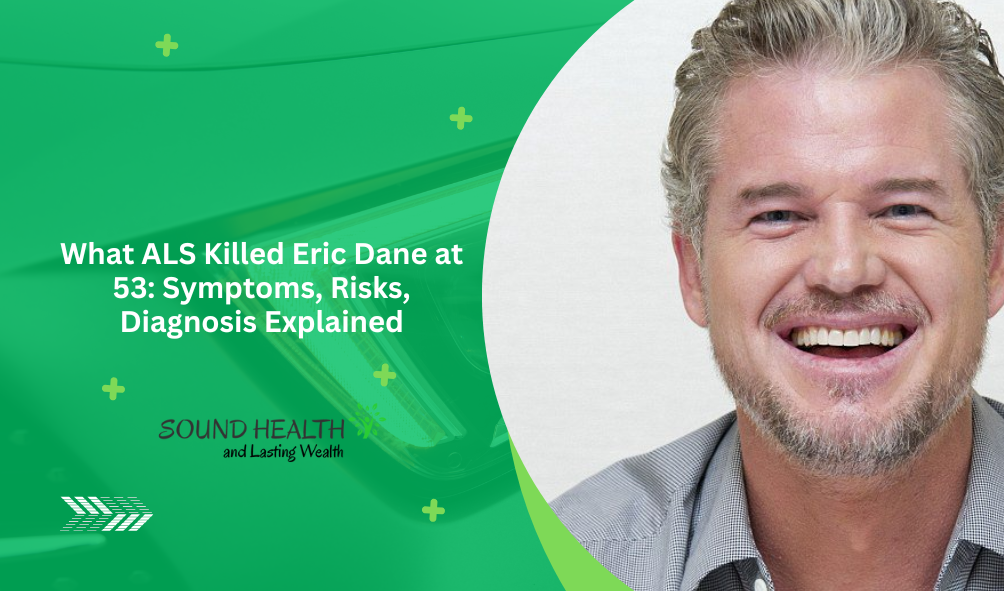

Actor Eric Dane, famous for playing Dr. Mark “McSteamy” Sloan on Grey’s Anatomy and Cal Jacobs on Euphoria, passed away on February 19, 2026, at age 53 after a rapid battle with Amyotrophic lateral sclerosis (ALS). Diagnosed in April 2025, his condition progressed unusually fast, turning a spotlight on this devastating neurodegenerative disease. This article covers his story and key facts about ALS to inform and honor his legacy.

Eric Dane’s ALS Symptoms Were Aggressive
Dane first noticed weakness in his right hand around late 2023 or early 2024, initially blaming it on too much texting. That subtle sign escalated quickly; by mid-2025, he struggled to swim, a skill from his competitive water polo days. Experts note such rapid decline is rare—ALS typically unfolds over years, but Dane’s case lasted just 10 months, highlighting aggressive variants driven by genetics or early bulbar involvement.
This swift progression led to muscle twitching, speech issues, and swallowing difficulties, common in ALS where motor neurons die off. In his final public talk in December 2025, Dane called the disease “so horrible,” reflecting its toll even as he filmed a role portraying an ALS-afflicted firefighter. Such anecdotes underscore why early vigilance matters.
Dane Credited His Daughter with Saving His Life
A pivotal moment came during a family snorkeling trip when Dane, unable to generate enough power to return to the boat, nearly drowned. His 13-year-old daughter, Georgia, pulled him to safety, an act he tearfully recounted in a June 2025 interview. “She dragged me back to the boat. I was breaking down in tears,” he shared, heartbroken yet grateful.
This incident forced him to confront his limits, prioritizing family amid decline. It exemplified ALS’s sneaky advance—strength fades without warning. Dane’s story shows how loved ones become lifelines, echoing broader patient experiences where caregivers step in early.
A Look at Eric Dane’s Final Days
Surrounded by wife Rebecca Gayheart, daughters Billie and Georgia, and close friends, Dane spent his last moments in peace despite bedridden state and loss of speech. A GoFundMe raised over $300,000 for medical bills and his girls’ future, signaling the financial strain of his fight.
He advocated fiercely till the end, partnering with I AM ALS on “Push for Progress” to secure $1 billion in research funding and renew the ACT for ALS Act. In his December panel, he pushed for faster cures, his voice a rallying cry. These efforts leave a mark beyond his 53 years.

Understanding Your ALS Risk and Symptoms
ALS strikes about 1.7 to 2.2 per 100,000 annually in the U.S., with prevalence near 5-9 per 100,000; cases may hit 36,000 by 2030. Men face slightly higher odds, peaking between 40-60, with risks from head trauma, smoking, solvents, pesticides, or heavy metals (OR ≥1.3).
Early symptoms mimic Dane’s: hand weakness, limb twitching (fasciculations), slurred speech, or tripping. Unlike slower cases, aggressive ones hit breathing or swallowing fast. Track changes like persistent muscle cramps or fatigue—these signal neuron loss.
Limb-onset ALS (70% of cases): Starts in arms/legs.
Bulbar-onset (25%): Affects speech/swallowing first, often quicker.
Familial ALS (10%): Genetic mutations like C9orf72.
How to Get an ALS Diagnosis
No single test confirms ALS; doctors use the patient’s history and exams like EMG to detect nerve damage. Start with a neurologist assessing strength, reflexes, and coordination—hyperreflexia or fasciculations raise flags.
Key steps include:
EMG/Nerve conduction studies: Show denervation in multiple regions.
MRI: Rules out mimics like spinal issues.
Blood/urine tests: Exclude infections or metabolic causes.
Pulmonary tests: Gauge breathing if advanced.
Diagnosis follows revised El Escorial criteria, needing upper/lower motor signs in limbs. Genetic screening helps familial cases. Dane’s path—from hand specialist to neurologist—mirrors this, stressing persistence for the 2-5 year average survival post-diagnosis. Seek specialists via ALS Association for clarity.
Also Read | Why That Odd Mouth Taste Lingers: Top 5 Doctor-Revealed Causes