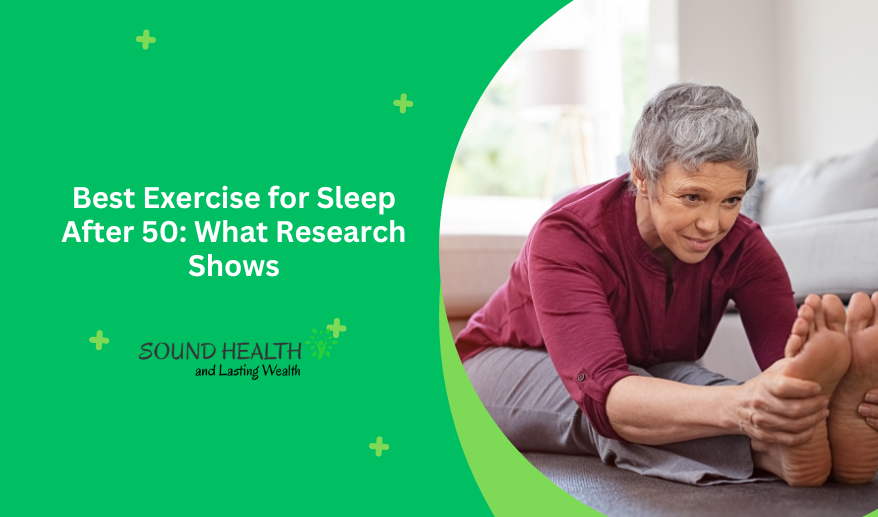
If sleep has become harder to come by after 50, exercise is one of the most useful, and most overlooked, tools you have. The encouraging news from recent research is that the exercise that helps most is not intense, and needs no gym.
A 2025 network meta-analysis in BMJ Evidence-Based Medicine pooled 22 randomised trials and ranked different types of exercise for insomnia. The standouts were yoga, Tai Chi, and walking or jogging, gentle, accessible activities that rivalled established treatments (Bu et al., 2025). In the analysis, yoga was associated with nearly two extra hours of sleep a night, and Tai Chi’s benefits lasted up to two years (Medical News Today, 2025).
One honest caveat up front: the researchers rated the certainty of this evidence as low, meaning the direction is promising but the exact numbers should be read as encouraging estimates, not guarantees. Still, the practical message is sound and low-risk: gentle, mindful movement is a genuinely good bet for better sleep after 50.
What you will learn:
- Why exercise helps sleep, and why gentle beats intense
- The three best exercises the research points to
- Simple ways to start with no equipment
- How to time exercise so it helps rather than hurts
- When poor sleep needs a doctor, not just a workout

Why Exercise Helps You Sleep
Exercise improves sleep through several routes: it eases anxiety and low mood, helps regulate your body clock, supports healthy daytime tiredness, and reduces some of the physical discomforts that fragment sleep.
There is a common assumption that exercise only helps sleep by wearing you out physically. The new research pushes back on that. The gentlest options, yoga and Tai Chi, performed best on several sleep measures, which suggests the calming, mind-body element matters at least as much as physical exhaustion (BACA, 2026). These activities combine slow movement with focused breathing, which lowers nervous-system arousal, the very state that keeps people lying awake.
For people over 50, this is good news. You do not need to punish yourself with hard workouts to sleep better. In fact, for sleep specifically, gentle and mindful may be the smarter choice.
Also Read | Women With These 5 Sleep Habits Live Longer, Study Finds
What the Research Actually Found
The 2025 analysis compared 13 approaches to insomnia across 22 trials and 1,348 participants, including seven types of exercise alongside treatments like cognitive behavioural therapy and sleep hygiene (Bu et al., 2025). Three exercise types clearly stood out.
| Exercise | What the analysis found | Notable feature |
|---|---|---|
| Yoga | Associated with up to nearly 2 more hours of sleep per night and about 15% better sleep efficiency | Strongest effect on total sleep time |
| Tai Chi | Improved sleep quality scores, added roughly 50 minutes of sleep, and reduced time awake | Benefits lasted up to about 2 years |
| Walking or jogging | Large reduction in insomnia severity scores | Simplest to start, no learning curve |
A few things make these findings genuinely useful:
- They rivalled CBT-I, the recommended first-line treatment for chronic insomnia, in this analysis (Medical News Today, 2025).
- They are accessible. None requires a gym, equipment, or athletic ability.
- Tai Chi’s durability stood out. Few sleep interventions show benefits lasting up to two years.
The honest caveat, again: the researchers graded the evidence as low-certainty, and called for larger, higher-quality trials to confirm the exact effects. So treat the specific numbers as encouraging rather than precise, while trusting the broad, low-risk conclusion that gentle exercise helps sleep.
The Best Exercises for Sleep After 50
Here is how to put the three winners into practice, with no equipment and gentle enough to start at any fitness level. Check with your doctor before beginning a new routine if you have a health condition or have been inactive.
1. Yoga
Yoga combines gentle stretching, slow movement, and breath control, and it showed the strongest effect on sleep duration in the research.
How to start with no equipment:
- Follow a free gentle or “restorative” yoga video aimed at beginners or older adults.
- Focus on slow, relaxing poses rather than demanding ones.
- A few simple evening stretches with slow breathing count.
- A rolled towel or cushion can replace any props.
Beginner-friendly, calming poses:
- Gentle seated forward fold
- Legs up the wall (lie down, rest your legs up against a wall)
- Reclined gentle twist
- Child’s pose
Aim for slow breathing throughout. The breathing is doing as much work as the movement.
Also Read | How Your Dreams Reveal Sleep Quality: Signs to Watch Tonight
2. Tai Chi
Tai Chi is a gentle Chinese practice of slow, flowing movements paired with deep breathing. It is famously easy on the joints and suits older adults well, and its sleep benefits were the longest-lasting in the research.
How to start with no equipment:
- Follow a free beginner Tai Chi video; many are designed for seniors.
- Wear comfortable clothes and flat shoes, or go barefoot on a non-slip surface.
- Start with 10 to 15 minutes and build gradually.
- Move slowly and smoothly; there is no rushing in Tai Chi.
Tai Chi also improves balance, which is a meaningful bonus after 50, since better balance reduces fall risk.
3. Walking or Jogging
The simplest option of all, and the one that most reduced insomnia severity in the analysis. No skill, no equipment beyond comfortable shoes.
How to make it work for sleep:
- Aim for a brisk daily walk, ideally outdoors.
- Morning or daytime daylight is a bonus, because light exposure helps set your body clock for better sleep at night.
- Build up gradually; even 20 to 30 minutes helps.
- Jogging is fine if your joints allow, but brisk walking is plenty.
Walking is the easiest habit to keep, and consistency matters more than intensity.
A Simple Evening Wind-Down Routine
If you want a gentle, no-equipment routine to try before bed, this takes about 10 minutes and uses nothing but the floor and a wall.
- Two minutes of slow breathing. Breathe in for four counts, out for six.
- Gentle seated forward fold, holding for several slow breaths.
- Reclined gentle twist, a few breaths on each side.
- Legs up the wall for two to three minutes, breathing slowly.
- Child’s pose to finish, with easy breathing.
Keep everything slow and comfortable. If any movement causes pain, skip it. The aim is to calm your nervous system, not to stretch hard.
Timing: When to Exercise for Better Sleep
Timing can make the difference between exercise that helps your sleep and exercise that disrupts it.
- Gentle mind-body exercise (yoga, Tai Chi) is fine in the evening and can be a lovely wind-down. Because it is calming rather than stimulating, it does not tend to disrupt sleep.
- Vigorous or intense exercise is best finished a few hours before bed. Recent research suggests hard, high-intensity workouts within a few hours of bedtime can delay sleep and lighten it, so leave a buffer.
- Daytime activity and daylight help most. Getting movement and natural light earlier in the day supports your circadian rhythm and evening sleepiness.
If you are unsure, listen to your own body. Some people are unaffected by an evening walk; others sleep worse after anything energetic late on. Track what works for you.
Getting Started After 50: Practical Tips
- Start small. Ten minutes counts. Consistency beats intensity for sleep.
- Choose what you enjoy. The best exercise for your sleep is the one you will actually keep doing.
- Use free resources. Plenty of gentle yoga and Tai Chi videos for older adults are freely available.
- Combine with daylight. A daytime walk gives you movement and light in one go.
- Be patient. Sleep benefits build over weeks, not overnight. The trials ran from 4 to 26 weeks.
- Pair with good sleep habits. Exercise works best alongside a consistent bedtime, a cool dark room, and limited evening caffeine and alcohol.
Also Read | How to Get Better Sleep After 50: 7 Simple Tips for Pain‑Free Nights
What Exercise Cannot Do
Exercise is a genuinely useful, low-risk tool, but it is not a cure-all, and it is important to be honest about its limits.
- It is not a guaranteed fix for chronic insomnia, and the strongest evidence still supports cognitive behavioural therapy for insomnia (CBT-I) as the first-line treatment.
- It will not resolve an underlying sleep disorder such as sleep apnea or restless legs syndrome, which need proper diagnosis and treatment.
- The research showing these benefits was low-certainty, so results vary between individuals.
Think of gentle exercise as a strong supporting player: safe, accessible, good for your whole body, and a genuine help for many people’s sleep. Just not a substitute for medical care when sleep problems are persistent or severe.
Myths vs. Facts
| Myth | Fact |
|---|---|
| You need intense workouts to sleep better | Gentle yoga and Tai Chi performed best in the research. |
| Exercise only helps sleep by tiring you out | The calming, mind-body element appears to matter as much. |
| You need a gym or equipment | Yoga, Tai Chi, and walking need none. |
| It is too late to start after 50 | These gentle options are ideal for starting later in life. |
| Any exercise before bed ruins sleep | Gentle evening movement is fine; intense late workouts are the issue. |
| Exercise can replace treatment for insomnia | CBT-I remains first-line; exercise is a helpful addition. |
Common Mistakes to Avoid
- Pushing too hard. Intensity is not the goal for sleep; gentleness and consistency are.
- Doing intense workouts right before bed. Leave a few hours after vigorous exercise.
- Expecting overnight results. Benefits build over weeks of regular practice.
- Skipping daylight. Daytime outdoor movement helps set your body clock.
- Assuming exercise fixes everything. It will not resolve sleep apnea or severe insomnia.
- Giving up early. Consistency is what delivers the benefit.
When to See a Doctor
Gentle exercise is a great starting point for restless nights. Some sleep problems need medical attention. See a doctor if you:
- Have had difficulty falling or staying asleep at least three nights a week for three months or more
- Wake unrefreshed despite spending enough time in bed
- Snore loudly, gasp, or have been told you stop breathing in your sleep
- Have an uncomfortable urge to move your legs in the evening
- Feel so sleepy during the day that it affects driving, work, or safety
It is also wise to check with your doctor before starting a new exercise routine if you have a heart condition, joint problems, balance issues, or have been inactive for a long time. For chronic insomnia, ask about CBT-I, the recommended first-line treatment, which pairs well with the gentle exercise described here.
Also Read | Feeling Tired Always? Doctors Reveal Sleep Hours by Age
Action Steps
- Pick one of the three: gentle yoga, Tai Chi, or a daily walk.
- Start with just 10 to 15 minutes and keep it comfortable.
- Use a free beginner video for yoga or Tai Chi if you are new to them.
- Get some of your movement in daylight to help your body clock.
- Keep vigorous exercise to earlier in the day; save gentle movement for evenings.
- Give it several weeks before judging the results.
- If sleep problems persist, see your doctor and ask about CBT-I.
Frequently Asked Questions
What is the best exercise for sleep after 50?
Recent research points to yoga, Tai Chi, and walking or jogging as the most effective for improving sleep and easing insomnia. Yoga showed the strongest effect on sleep duration, and Tai Chi’s benefits lasted the longest.
Do I need a gym or equipment?
No. Yoga, Tai Chi, and walking need no gym and no special equipment, just comfortable clothes and, for walking, supportive shoes.
How much exercise do I need to improve my sleep?
Even short sessions help, and consistency matters more than intensity. Start with 10 to 20 minutes and build gradually. Sleep benefits develop over several weeks.
Is it okay to exercise in the evening?
Gentle mind-body exercise like yoga or Tai Chi is fine and can be calming before bed. Vigorous, intense exercise is best finished a few hours before bedtime.
How quickly will I see results?
Give it several weeks. The studies ran from 4 to 26 weeks, and benefits build over time rather than appearing overnight.
Will exercise cure my insomnia?
It can meaningfully help, but it is not a guaranteed cure. For chronic insomnia, cognitive behavioural therapy for insomnia (CBT-I) remains the recommended first-line treatment, and exercise works well alongside it.
Is yoga safe if I am not flexible or have never done it?
Yes, with a gentle, beginner-friendly approach. Choose restorative or senior-focused routines, move within your comfort, and stop anything that causes pain. Check with your doctor if you have health concerns.
Does walking really help sleep as much as the others?
In the analysis, walking or jogging produced the largest reduction in insomnia severity. It is also the easiest habit to maintain, which matters for long-term results.
Key Takeaways
- A 2025 analysis found yoga, Tai Chi, and walking or jogging were the most effective exercises for improving sleep and easing insomnia.
- Yoga was linked to nearly two extra hours of sleep a night; Tai Chi’s benefits lasted up to two years.
- These gentle activities rivalled established insomnia treatments and need no gym or equipment.
- The calming, mind-body element appears as important as physical tiredness.
- The evidence was rated low-certainty, so treat the specific numbers as encouraging estimates.
- Gentle evening movement is fine; save vigorous exercise for earlier in the day.
- Exercise helps many people but does not replace CBT-I or treatment for sleep disorders.
The Bottom Line
If sleep has slipped since you turned 50, you do not need a gym membership or a punishing workout to reclaim it. The research points somewhere gentler and more welcoming: yoga, Tai Chi, and a daily walk, all free, all accessible, and all genuinely helpful for sleep.
Keep two things in mind. First, gentleness is a feature, not a compromise. The calmest options performed best, likely because they quiet the nervous system that keeps you awake. Second, be patient and consistent; the benefits build over weeks, and with Tai Chi they may last for years.
Start with ten minutes of whichever appeals to you most, ideally with a little daylight, and give it a few weeks. And if poor sleep persists despite your best efforts, treat that as a reason to see your doctor rather than a personal failing. Gentle movement is a wonderful place to start, and for many people over 50, it is enough to make the nights easier.
Also Read | Sleep Problems Linked to Higher Heart Disease Risk After 45
References
Bu, Z. J., Liu, F. S., Shahjalal, M., Song, Y. K., Li, M. C., Zhuo, R. E., Zhong, Q. H., Du, Y. W., Lu, C. G., Yang, Z. H., Yang, H. Y., Zhong, P., Liu, J. P., & Liu, Z. L. (2025). Effects of various exercise interventions in insomnia patients: A systematic review and network meta-analysis. BMJ Evidence-Based Medicine. https://doi.org/10.1136/bmjebm-2024-113512
BMJ Group. (2025, July 16). Yoga, Tai Chi, walking and jogging may be best forms of exercise for insomnia. https://bmjgroup.com/yoga-tai-chi-walking-and-jogging-may-be-best-forms-of-exercise-for-insomnia/
British Association for Counselling and psychotherapy resources / BACA. (2026). What kind of exercise works best for insomnia? https://baca.org/blog/exercise-works-best-insomnia/
CNN Health. (2025, July 17). How to improve sleep: These 3 exercises may help with insomnia, study finds. https://www.cnn.com/2025/07/17/health/insomnia-treatment-exercise-sleep-wellness
Medical News Today. (2025, July 19). 3 types of exercise may be best for managing insomnia. https://www.medicalnewstoday.com/articles/3-types-exercise-yoga-tai-chi-walking-may-be-best-managing-insomnia
Mayo Clinic. (2024). Exercising for better sleep. https://www.mayoclinic.org/healthy-lifestyle/adult-health/expert-answers/exercise/faq-20057943
National Health Service. (2024). Insomnia. https://www.nhs.uk/conditions/insomnia/
World Health Organization. (2020). WHO guidelines on physical activity and sedentary behaviour. https://www.who.int/publications/i/item/9789240015128