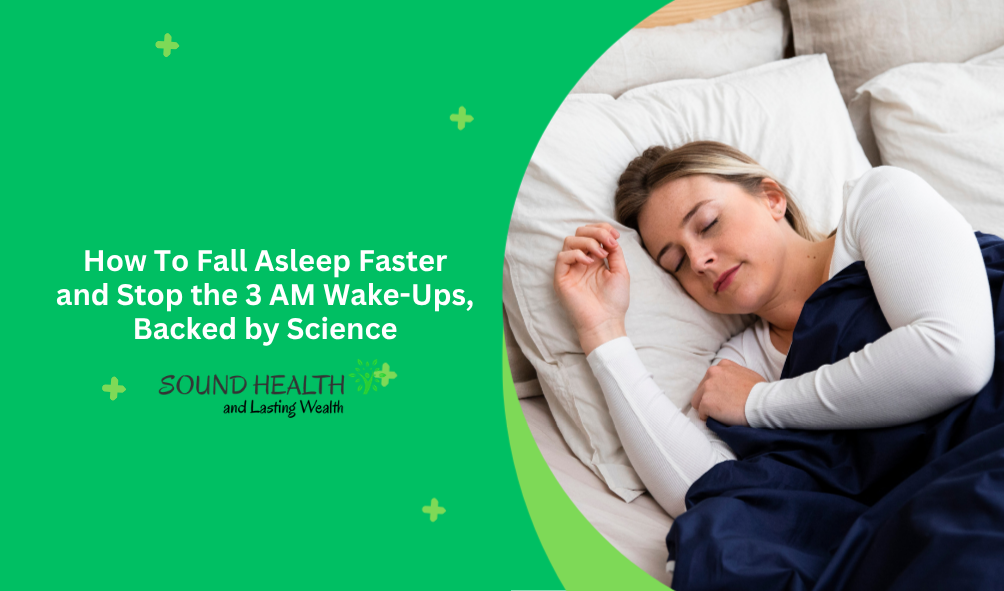
There are really two sleep problems that keep people up: not being able to fall asleep, and not being able to stay asleep. If you have lain awake willing yourself to drift off, or snapped awake at 3 a.m. and watched the ceiling for an hour, you know how maddening both can be.
The encouraging news is that there are real, expert-backed techniques for each, and most are free, simple, and low-risk. Not every viral sleep hack lives up to the hype, so this guide sorts the tricks that genuinely help from the ones that are merely popular, covering how to fall asleep faster, how to stop waking at 3 a.m., and the foundations that make any technique work better. It also flags when sleep trouble is more than a bad-habit problem and deserves a doctor’s attention.

Key Takeaways
- Several relaxation and distraction techniques can help you fall asleep faster, mostly by lowering mental and physical arousal.
- For waking at 3 a.m., the most effective moves are not clock-watching, getting out of bed if you are stuck, and keeping a steady wake time.
- The strongest evidence is for the behavioral approach known as CBT-I and its components, not for any single viral hack.
- Tricks work far better on a foundation of consistent, healthy sleep habits.
- Persistent insomnia, or loud snoring and gasping, should be assessed by a doctor.
Tricks To Fall Asleep Fast
The common thread in every fall-asleep-fast method is the same: calm the body and quiet the mind, since sleep comes when arousal drops. These are worth trying, with an honest note on how well each is supported.
The Military Method
This popular technique is essentially relaxation in a fixed order. Relax the muscles of your face, drop your shoulders and let your arms fall, relax your chest, then your legs, and spend about ten seconds trying to clear your mind. It is really progressive muscle relaxation paired with mental quieting, which are legitimate calming tools. The claim that it works in two minutes is anecdotal, but the underlying approach is sound and harmless to try.
Slow, Extended Breathing
Breathing techniques are among the most reliable ways to downshift. In the 4-7-8 method, you inhale through the nose for a count of four, hold for seven, and exhale slowly through the mouth for eight. The physiological sigh, two inhales followed by a long exhale, works on the same principle. A long, slow out-breath activates the body’s rest-and-recovery system, easing you toward sleep. Of the breathing methods, cyclic sighing has the most recent research support for calming the body.
The Cognitive Shuffle
If a racing or worried mind is what keeps you awake, this mental trick helps. You deliberately think of random, unconnected words or images, a key, a beach, a lamp, a dog, with no story linking them. The randomness blocks the anxious, logical thinking that fuels wakefulness and mimics the loose, drifting thoughts that naturally precede sleep.
Paradoxical Intention
This one sounds backward but is a recognized technique within behavioral sleep therapy. Instead of desperately trying to fall asleep, you gently try to stay awake. Removing the pressure and performance anxiety around sleep often lets it come more easily. It is particularly useful for people who get frustrated and tense the harder they try.
Progressive Muscle Relaxation and Deep Rest
Tensing and then releasing each muscle group in turn, from your feet upward, releases physical tension you may not realize you are holding. Guided deep-relaxation practices, sometimes called non-sleep deep rest, work similarly, walking you into a calm state in which sleep tends to follow.
A fair summary: most of these are low-risk relaxation or distraction methods rooted in sound principles. The strongest formal evidence is for relaxation techniques and paradoxical intention, which are part of behavioral sleep therapy, while methods like the military method and cognitive shuffle are popular and plausible but less rigorously tested. Try a couple and keep what works for you.
Tricks To Stop Waking Up at 3 a.m.
Waking briefly in the night is normal, since sleep is lighter in the early hours. The real problem is being unable to fall back asleep. These moves target exactly that. For a deeper look at why the 3 a.m. wake-up happens in the first place, see our full guide on it.
- Do not watch the clock. Turn it away. Calculating lost sleep only raises anxiety and alertness.
- Use the 20-minute rule. If you are awake and frustrated for roughly fifteen to twenty minutes, get out of bed, keep the lights low, do something calm and boring, and return only when sleepy. This stops your brain associating the bed with lying awake.
- Keep a steady wake time. Getting up at the same time every day, including weekends, anchors your body clock and improves sleep over time.
- Cut the usual triggers. Evening alcohol causes rebound waking a few hours later, and late caffeine or heavy meals fragment sleep.
- Calm the racing mind. Slow breathing or a brief worry-dump on paper earlier in the evening can keep 3 a.m. thoughts from taking over.
The Foundations That Make the Tricks Work
No technique works well on a shaky foundation. The basics of healthy sleep make every trick more effective. Keep a consistent sleep and wake schedule. Get bright light, ideally sunlight, soon after waking to anchor your body clock. Keep your bedroom cool, dark, and quiet. Give yourself a calm, screen-light buffer before bed, since phone and screen light and content both raise alertness. And keep caffeine to earlier in the day while going easy on evening alcohol. Think of these as the soil; the tricks are seeds that grow far better in it.
What the Evidence Really Says
Honesty matters here, because the internet overflows with sleep hacks. The single most effective, best-supported approach for ongoing sleep trouble is not a viral trick at all. It is cognitive behavioral therapy for insomnia, usually shortened to CBT-I, which sleep specialists consider the first-line treatment for chronic insomnia, ahead of sleeping pills. Several of the techniques above, including relaxation, stimulus control, and paradoxical intention, are actually components of CBT-I, which is why they have real backing.
The flashier fall-asleep-fast methods are mostly low-risk and plausible, and many people find them helpful, but they are not magic and are less rigorously proven as standalone cures. They help primarily by lowering arousal, which is genuinely useful, rather than by switching sleep on. Set your expectations accordingly, and lean on the well-supported behavioral basics for lasting change.
What To Avoid
A few instinctive responses backfire. Do not lie in bed clock-watching or doing mental math about lost sleep. Do not reach for your phone, since the light and content both wake you further. Do not try hard to force sleep, as effort is the enemy of it. Avoid using alcohol as a sleep aid, since it worsens night waking. Skip long daytime naps that reduce your sleep drive. And do not rely on sleeping pills indefinitely without medical guidance; they have a short-term place, but behavioral approaches work better over time.
When To See a Doctor
Occasional bad nights are part of life, but some patterns need professional help. See a doctor if you have trouble sleeping at least three nights a week for three months or more, if poor sleep is affecting your mood, focus, or safety by day, or if a bed partner notices loud snoring, choking, or pauses in your breathing, which can indicate sleep apnea. Persistent early waking alongside low mood or heavy anxiety also warrants attention. A clinician can identify treatable causes and point you to CBT-I, which no single trick replaces.
What the Evidence Does NOT Prove
A few clarifications keep expectations realistic. No technique guarantees you will fall asleep instantly every night, and claims of two-minute sleep for everyone are overstated. Waking briefly during the night is normal and not a disorder in itself. And these tricks are not a cure for insomnia, sleep apnea, or an underlying medical or mental health condition; they are tools to lower arousal and support sleep, most powerful when combined with healthy habits and, where needed, proper treatment.
The Bottom Line
Falling asleep fast and staying asleep both come down to one thing: lowering the mental and physical arousal that keeps you awake. For drifting off, try relaxation and breathing techniques, the cognitive shuffle or paradoxical intention, and keep whatever works. For 3 a.m. waking, resist the clock, use the twenty-minute rule, hold a steady wake time, and cut evening triggers.
Build these on a foundation of consistent, healthy sleep habits, and remember that the best-supported long-term answer for stubborn insomnia is the behavioral approach known as CBT-I. Treat persistent problems, loud snoring, or daytime exhaustion as reasons to see a doctor. With the right tricks and the right expectations, better nights are well within reach.
Also Read | Chronic Pain During Menopause: Why Midlife Women May Hurt More