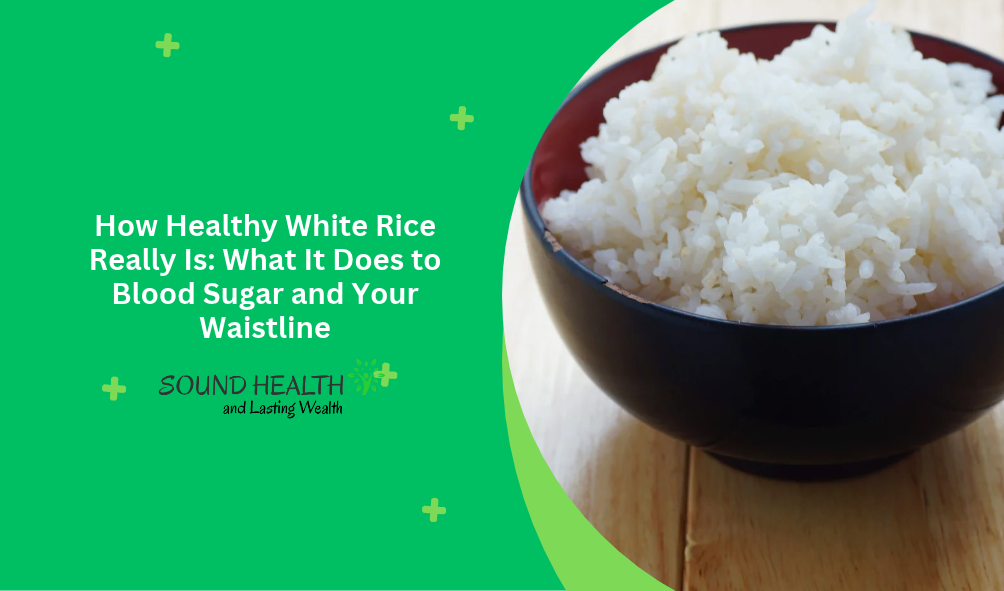
White rice is not unhealthy in itself, but it is not a healthy food either. It is a refined grain that has lost most of its fiber, so it raises blood sugar faster than brown rice, and large studies link eating a lot of it to a higher risk of type 2 diabetes. In moderate portions, as part of a balanced plate, it can still fit into a healthy diet.
As registered dietitian Beth Czerwony of Cleveland Clinic puts it, white rice is not the best food for you, but it is not going to hurt you either. The details lie in how much you eat, how often, and what you eat it with. Here is what the evidence says about white rice, blood sugar, and weight, and how to enjoy it more wisely.
Key Takeaways
- White rice is a refined grain. Milling removes most of its fiber, B vitamins, and minerals.
- It has a higher glycemic index than brown rice, so it raises blood sugar faster.
- Eating more white rice is linked to a higher risk of type 2 diabetes, especially in populations that eat it daily.
- There is no strong evidence that white rice alone causes weight gain, but large portions add up quickly.
- Smaller portions, plenty of vegetables and protein, and mixing in whole grains make rice meals healthier.
What Makes White Rice Different From Brown Rice
Every grain of rice starts with three parts: the bran, the germ, and the starchy endosperm. Brown rice keeps all three, which makes it a whole grain. White rice is milled and polished until only the endosperm remains.
According to the Harvard T.H. Chan School of Public Health’s Nutrition Source, that process removes most of the naturally occurring B vitamins, minerals, phytochemicals, and fiber. Many brands are enriched to add some vitamins back, but Czerwony notes that the final product still falls short of where it started. Brown rice keeps more fiber, magnesium, manganese, phosphorus, and B vitamins.
What White Rice Does to Blood Sugar
Because white rice is mostly starch with little fiber to slow it down, the body digests it quickly into glucose. The Nutrition Source describes rice as a high glycemic index food, with values ranging widely by variety and processing, and gives an average of 64 for white rice compared with 55 for brown rice. The higher the number, the faster a food raises blood sugar.
For most healthy people, the body handles that rise without trouble. It matters more for people with diabetes or prediabetes, and for anyone who eats large portions of white rice several times a day, since repeated sharp rises ask more of the body’s insulin response over time.
White Rice and Type 2 Diabetes Risk
The best-known evidence comes from a 2012 analysis in the BMJ led by researchers at the Harvard School of Public Health. It pooled seven studies from China, Japan, the United States, and Australia, covering more than 350,000 people followed for 4 to 22 years.
- People in Asian populations who ate the most white rice had a 55 percent higher risk of type 2 diabetes than those who ate the least.
- In Western populations, where people eat far less rice, the link was smaller and not statistically significant.
- Overall, each additional daily serving, about one cup of cooked rice, was associated with an 11 percent higher risk.
Separate research in American adults, summarized by the Nutrition Source, found that people eating five or more servings of white rice a week had a 17 percent higher risk than those eating less than one a month, while those eating the most brown rice had an 11 percent lower risk.
These are associations, not proof that rice causes diabetes. The BMJ authors noted that factors such as income and overall diet could not be fully ruled out. Still, the pattern is consistent: the more white rice a diet relies on, the higher the risk tends to be.
What White Rice Does to Your Waistline
There is no strong evidence that white rice by itself causes weight gain. Weight depends on your total diet and activity, and many populations that eat rice daily have historically been lean.
Where rice can work against you is portion size and fullness. White rice has little fiber, so it is easy to eat a large plate without feeling full for long. Czerwony points out that brown rice keeps you feeling full longer, which helps when you are watching how much you eat. A heaped plate of rice cooked in a lot of oil, as with fried rice or some party jollof, carries far more calories than a modest serving of plain boiled rice.
When White Rice Is the Better Choice
White rice has a place. Czerwony notes that enriched white rice is a good source of folic acid, which matters before and during pregnancy. Its low fiber also makes it easier to digest, so it is often recommended for people on a low-fiber diet or with a sensitive stomach.
There is also arsenic to consider. Rice absorbs arsenic from the water and soil it grows in, and the Nutrition Source notes that brown rice contains more than white rice because arsenic builds up in the outer layers. This is not a reason to avoid brown rice, but it is one reason not to rely on any single grain.
How To Eat White Rice in a Healthier Way
You do not have to give up rice. A few changes make a real difference.
- Watch the portion. Treat rice as one part of the plate, not the whole plate. A cupped handful to about one cup of cooked rice is a sensible serving for most adults.
- Fill the rest of the plate. Add vegetables, beans, and a lean protein such as fish, chicken, or eggs. Fiber, protein, and fat slow how fast the meal raises blood sugar.
- Mix in whole grains. Czerwony often suggests mixing brown and white rice. Less-polished local rice and other grains such as millet, barley or quinoa are also options.
- Go easy on oil. Plain boiled rice with stew on the side is lighter than fried rice or rice cooked in a lot of oil.
- Rinse before cooking. The Nutrition Source recommends rinsing rice in cool water until it runs clear, and notes that cooking in extra water and draining it removes about half the arsenic, along with some B vitamins.
- Try cooled rice. In a small study of 15 healthy adults, published in the Asia Pacific Journal of Clinical Nutrition in 2015, white rice that was cooked, refrigerated for 24 hours, and then reheated produced a lower blood sugar response than freshly cooked rice. Cooling increases resistant starch, a type of starch that behaves more like fiber. If you do this, refrigerate leftover rice promptly and reheat it thoroughly.
What the Evidence Does NOT Prove
The research does not show that white rice is toxic, that one plate will harm you, or that you must cut it out completely. The diabetes studies measure long-term eating patterns and cannot rule out other differences between people who eat a lot of rice and those who do not.
It also does not prove that switching to brown rice will prevent diabetes on its own. Overall diet quality, body weight, physical activity, and family history all matter more than any single food. The cooled rice finding comes from one small study, so treat it as an interesting tip, not a treatment.
Who Should Be More Careful
People with type 2 diabetes or prediabetes benefit most from watching rice portions and pairing rice with protein and vegetables. If you check your blood sugar, testing about two hours after a rice meal shows how your own body responds.
Anyone with a family history of diabetes, a large waist measurement, or a mostly rice-based diet may also want to shift some meals toward whole grains and beans.
When To See a Doctor
Talk to a doctor or dietitian if you have been told your blood sugar is high, if you have diabetes and your readings rise sharply after meals, or if you are trying to lose weight and are unsure how rice fits in.
See a doctor promptly for signs of high blood sugar such as constant thirst, frequent urination, blurred vision, unexplained weight loss, or tiredness that does not lift.
The Bottom Line
White rice is a refined grain that raises blood sugar faster than whole grains, and diets built heavily around it are linked to a higher risk of type 2 diabetes. It does not, on its own, make you gain weight, but large, oily portions can.
The healthiest approach is not to fear rice but to put it in its place: a modest portion, surrounded by vegetables, beans, and protein, with whole grains mixed in where you can. Eaten that way, white rice can stay on the menu.
Also Read | The Truth About Fasting and Type 2 Diabetes
References
- Cleveland Clinic. (2021, June 11). Brown rice or white rice: Which is your healthier option? https://health.clevelandclinic.org/brown-rice-or-white-rice-which-is-your-healthier-option
- Harvard T.H. Chan School of Public Health. (n.d.). Rice. The Nutrition Source. https://nutritionsource.hsph.harvard.edu/food-features/rice/
- Hu, E. A., Pan, A., Malik, V., & Sun, Q. (2012). White rice consumption and risk of type 2 diabetes: Meta-analysis and systematic review. BMJ, 344, e1454. https://pmc.ncbi.nlm.nih.gov/articles/PMC3307808
- Effect of cooling of cooked white rice on resistant starch content and glycemic response. (2015). Asia Pacific Journal of Clinical Nutrition. https://pubmed.ncbi.nlm.nih.gov/26693746/