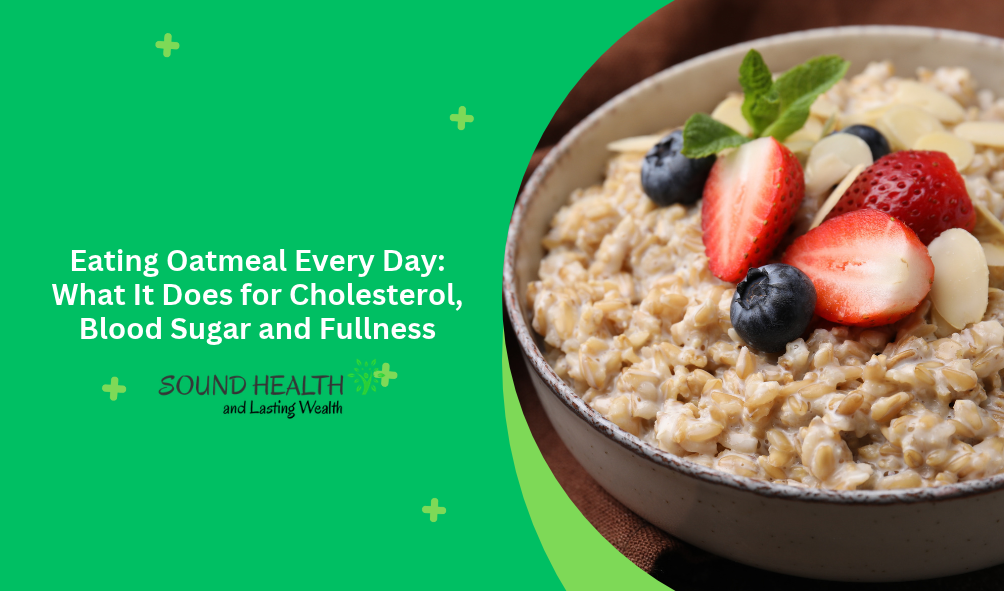
A warm bowl of oatmeal is one of the simplest breakfasts there is, and one of the best studied. Eaten every morning, oatmeal can help lower your cholesterol, steady your blood sugar, and keep you feeling full until lunch. Much of that comes from beta-glucan, a soluble fiber found in oats that turns thick and gel-like in your gut.
Those benefits are real, but they depend on the kind of oats you buy and what you put on top. A sugary instant packet is not the same as a bowl of rolled oats with fruit. Here is what happens in your body when oatmeal becomes a daily habit, and how to get the most out of it.

Key Takeaways
- Oats contain beta-glucan, a soluble fiber that can lower cholesterol when eaten regularly.
- The FDA allows foods made with whole oats to claim they may reduce the risk of heart disease, as part of a diet low in saturated fat and cholesterol.
- Oats can help lower blood sugar, especially less-processed types such as steel-cut and rolled oats.
- Oatmeal helps you feel full, but on its own it is not a proven weight-loss food.
- Flavored instant oats often contain added sugar, so check the label.
What Is in a Bowl of Oatmeal
According to the American Heart Association, one cooked cup of oatmeal contains about 166 calories and nearly 4 grams of fiber, along with useful amounts of thiamin and manganese. Harvard’s Nutrition Source adds that oats supply phosphorus, magnesium, and zinc.
The standout ingredient is beta-glucan, the main soluble fiber in oats. Oats also contain avenanthramides, plant compounds found almost only in oats that may have antioxidant and anti-inflammatory effects, although Candida Rebello, PhD, of Louisiana State University’s Pennington Biomedical Research Center notes they are far less researched than beta-glucan.
Your Cholesterol May Come Down
This is the best-established benefit. When beta-glucan mixes with water in your gut, it forms a thick gel. That gel is thought to help remove cholesterol from the body before it is absorbed.
The evidence is strong enough that the US Food and Drug Administration allows a health claim for whole oat foods. Under federal rules, products can state that diets low in saturated fat and cholesterol that include 3 grams or more per day of beta-glucan soluble fiber from whole oats may reduce the risk of heart disease. Harvard’s Nutrition Source reports that a meta-analysis found 3 grams of oat beta-glucan a day modestly lowered blood cholesterol by about 12 points. Rebello describes beta-glucan’s effect on cholesterol as shown “quite unequivocally.”
A single bowl will not get you all the way to 3 grams on its own for most people, but it makes a solid start. Adding oat bran, as Harvard suggests, increases the amount.
Your Blood Sugar May Stay Steadier
Beta-glucan slows digestion, which means sugar from your meal enters the bloodstream more gradually. Harvard’s Nutrition Source reports that a meta-analysis of controlled trials found oats significantly reduced fasting blood glucose and HbA1c, a measure of average blood sugar, especially in people whose levels were high to start with. In a trial of 298 adults with type 2 diabetes, eating 50 or 100 grams of oats a day reduced blood sugar after meals more than control diets did.
The type of oats matters here. Less-processed oats, such as steel-cut and old-fashioned rolled oats, digest more slowly and have a lower glycemic index. Instant oats are processed more, so they raise blood sugar faster.
You May Feel Fuller for Longer
That thick gel also adds bulk to your meal and slows how quickly your stomach empties, which can help you feel satisfied. Harvard notes that several trials support this effect on fullness.
Fullness is not the same as weight loss, though. Harvard’s Nutrition Source states that studies have not consistently shown that eating oats leads to significant weight loss. Oatmeal can help you feel less hungry mid-morning, but your overall diet decides what happens to your weight.
Your Gut May Benefit
Bacteria in your large intestine ferment beta-glucan, and Harvard reports that this may increase the diversity of your gut microbes. That could help with constipation and other digestive complaints, though more research is needed. If you are not used to much fiber, increase your portion gradually and drink enough water to avoid bloating.
Steel-Cut, Rolled or Instant: Does It Matter?
All three are whole grain oats. The difference is how much they are cut and flattened.
| Type | How it is made | Cooking time | Effect on blood sugar |
|---|---|---|---|
| Steel-cut | Whole oats chopped into pieces | About 25 to 30 minutes | Slowest |
| Rolled (old-fashioned) | Steamed and pressed flat | About 5 minutes | Slow |
| Instant | Rolled very thin and precooked | 1 to 2 minutes | Fastest |
According to Rebello, there is little nutritional difference between steel-cut and rolled oats, while instant oats have a higher glycemic index. If convenience matters, rolled oats are a good middle ground. Plain instant oats are still a whole grain, but the flavored versions are where problems start.
Mistakes That Cancel Out the Benefits
- Flavored instant packets. Many contain a lot of added sugar. Harvard advises checking labels and choosing those with no added sugar.
- Heavy sweetening at home. Spoonfuls of sugar, syrup, or sweetened condensed milk add up quickly.
- Thinking oatmeal fixes everything. Rebello warns that a healthy breakfast will not make up for a day of high-sugar, high-fat eating.
- Assuming oat milk counts. The AHA notes that oat milk contains only small amounts of beta-glucan and may have added sugar, salt, or oil.
How To Build a Healthier Bowl
- Start with steel-cut or rolled oats.
- Cook them in water or low-fat milk.
- Sweeten with fruit such as banana, berries or mango.
- Add unsalted nuts or seeds for protein and healthy fats.
- Stir in two to three tablespoons of oat bran for extra fiber.
- Try overnight oats, soaked in milk in the fridge, for busy mornings.
A Note on Gluten and Celiac Disease
Oats do not contain wheat gluten, but they are often grown and processed alongside wheat, barley and rye, so ordinary oats can be contaminated. Coeliac UK, the UK charity for people with celiac disease, also notes that oats contain avenin, a protein similar to gluten.
Coeliac UK says most people with celiac disease can safely eat oats labeled gluten-free, but a small number still react to them. If you have celiac disease or gluten sensitivity, choose oats labeled gluten-free and discuss them with your doctor or dietitian.
What the Evidence Does NOT Prove
The research does not show that oatmeal on its own prevents heart disease or diabetes. The FDA claim applies only as part of a diet low in saturated fat and cholesterol, and it does not promise any specific reduction in risk. Harvard also notes that much of the research looks at whole grains in general, and that oat-specific studies vary in design and size.
The evidence for weight loss is the weakest. Oatmeal can help with fullness, but it is not a weight-loss treatment.
When To Talk to a Doctor or Dietitian
Talk to a doctor or dietitian if you are using oats to help manage high cholesterol or diabetes, since diet works best alongside any treatment you have been prescribed. If you have diabetes, checking your blood sugar after an oatmeal breakfast shows how your own body responds.
See a doctor if you get bloating, stomach pain, or diarrhea after eating oats that does not settle, or if you have symptoms of celiac disease such as ongoing diarrhea, weight loss, or tiredness.
The Bottom Line
Eating oatmeal every morning is a simple, inexpensive habit with real benefits. Its beta-glucan fiber can help lower cholesterol, steady blood sugar, and keep you full, and oats supply useful vitamins and minerals.
To get those benefits, choose steel-cut or rolled oats, skip the sugary flavored packets, and top your bowl with fruit, nuts, or seeds. Oatmeal will not do everything on its own, but as part of a balanced diet, it is one of the best ways to start the day.
Also Read | What Your Nails Say About Your Health: Changes Doctors Want You To Notice
Sources
Harvard T.H. Chan School of Public Health. (n.d.). Oats. The Nutrition Source. https://nutritionsource.hsph.harvard.edu/food-features/oats/ Evidence note: University nutrition resource summarizing trials and meta-analyses. Source for the cholesterol, blood sugar, fullness, gut, and weight findings, oat types, and the limits of the evidence.
U.S. Food and Drug Administration. (current). 21 CFR 101.81: Health claims: Soluble fiber from certain foods and risk of coronary heart disease. Electronic Code of Federal Regulations. https://www.ecfr.gov/current/title-21/chapter-I/subchapter-B/part-101/subpart-E/section-101.81 Evidence note: Federal regulation. Source for the 3-gram-per-day beta-glucan amount and the permitted wording of the heart disease claim.
Merschel, M. (2022, September 1). Take a fresh look at oatmeal. It’s not as simple as you think. American Heart Association News. https://www.heart.org/en/news/2022/09/01/take-a-fresh-look-at-oatmeal-its-not-as-simple-as-you-think. Evidence note: Professional body news article. Source for nutrition per cup, Candida Rebello’s comments, oat types, and oat milk. The page notes it is more than two years old.
Coeliac UK. (n.d.). Oats. https://www.coeliac.org.uk/living-with-coeliac-disease/food-and-drink/food-and-drink-information/oats/ Evidence note: National patient charity guidance. Source for avenin, contamination, and gluten-free oat labeling.