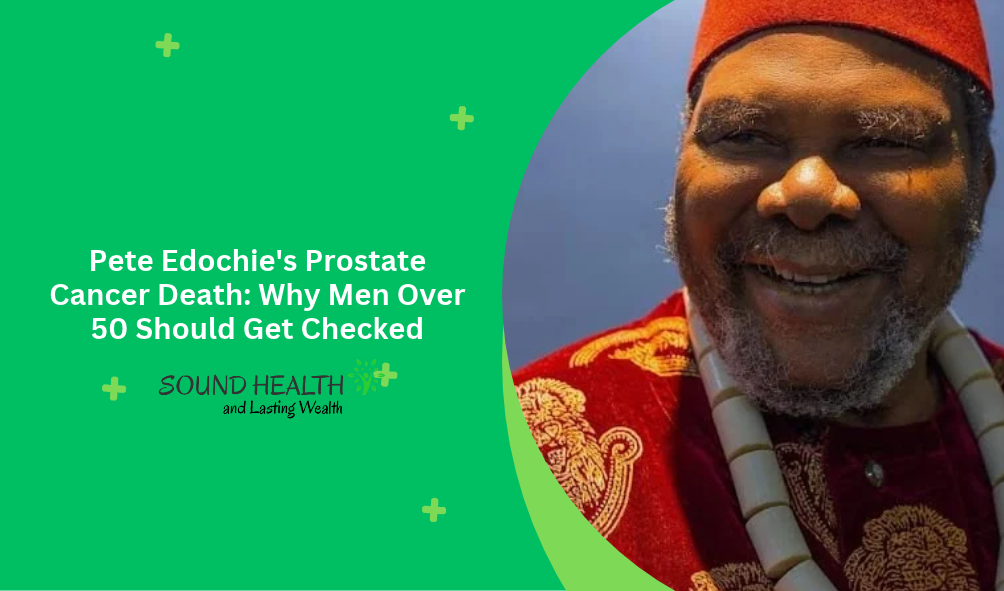
Nigeria is mourning Chief Pete Edochie, the veteran actor and broadcaster famous for playing Okonkwo in Things Fall Apart. His family says he died at 12:30 a.m. on Wednesday, November 25, 2026, in Enugu, “after a protracted battle with prostate cancer.” He was 79.
If you are a man over 40, or you love one, his passing is a painful reminder to take prostate health seriously. Here is the most important thing to know: early prostate cancer usually has no symptoms. That is why talking to a doctor about your risk, before anything feels wrong, can make all the difference.

Key Takeaways
- Pete Edochie died on November 25, 2026, after a long battle with prostate cancer, according to his family.
- Prostate cancer is the most common cancer among men in Nigeria and the leading cause of cancer death in Nigerian men, according to the World Health Organization’s cancer agency.
- Most men with early prostate cancer have no symptoms, so waiting for signs is risky.
- Possible warning signs include frequent urination, trouble urinating, blood in the urine or semen, and pain in the back, hips or pelvis.
- Black men face about double the risk of other men, and men with a father or brother who had prostate cancer are at higher risk too.
- Screening decisions are personal. Talk with a doctor about the benefits and limits of the PSA blood test.
What Happened to Pete Edochie
The family shared the news on Instagram in a statement titled “An Iroko Has Fallen,” signed by his son, Chief Leo Edochie.
“With profound sadness and hearts bowed in total submission to the will of Almighty God, we announce the passing of our beloved husband, father, brother and kinsman, Chief Dr Pete EDOCHIE, MON,” the statement read. It said he died “after a protracted battle with prostate cancer in Enugu, Nigeria.”
The News Agency of Nigeria reported that in October 2026, during a visit to Ghana, Edochie had spoken about declining health, including difficulty walking and swelling in parts of his body. Later, he said he hoped to recover but prayed not to become a burden to others, Pulse Nigeria reported.
President Bola Tinubu paid tribute, saying, “In his works, he lives forever.” Anambra State Governor Chukwuma Soludo called him “more than an actor. He was an institution,” according to Vanguard.
The family has not shared details of when he was diagnosed, what stage the cancer was, or what treatment he received. Funeral arrangements will be announced later.
Adieu, Pete Edochie: An Iroko Has Fallen
Legendary actor and broadcaster Chief Dr Pete Edochie, MON, passed away in Enugu in the early hours of Wednesday, aged 79.
Best known as Okonkwo in the NTA adaptation of Chinua Achebe’s Things Fall Apart, he has been mourned by Enugu Governor Peter Mbah, who called him a titan, a legend and an icon. Anambra Governor Chukwuma Soludo hailed him as a cultural giant.
He is survived by his wife, Josephine, and his children, including actor Yul Edochie.
Rest in peace, Okonkwo. 🕊️
Watch What’s Trending With @OjyOkpe
— ARISE NEWS (@ARISEtv) November 25, 2026
What Is Prostate Cancer?
The prostate is a small gland, about the size of a walnut, that sits below a man’s bladder. It helps make the fluid that carries sperm.
Prostate cancer happens when cells in this gland start to grow out of control. Some prostate cancers grow very slowly and may never cause harm. Others grow faster and can spread to the bones and other parts of the body.
That difference is one reason doctors take a careful, personal approach to testing and treatment.
Why Prostate Cancer Matters So Much in Nigeria
Prostate cancer is a major health concern for Nigerian men.
According to the Global Cancer Observatory fact sheet for Nigeria, published by the International Agency for Research on Cancer (IARC), the World Health Organization’s cancer agency:
| Measure | Figure |
|---|---|
| New prostate cancer cases in Nigeria | 24,396 a year |
| Share of all new cancers in Nigerian men | 39% |
| Rank among cancers in men | 1st for new cases and deaths |
| Prostate cancer deaths | 15,176 a year |
In plain terms, prostate cancer is the cancer Nigerian men are most likely to be diagnosed with, and most likely to die from.
Prostate Cancer Signs Men Should Know
The U.S. Centers for Disease Control and Prevention (CDC) lists these possible symptoms:
- Frequent urination, especially needing to go often
- Trouble urinating, such as a weak flow or difficulty starting
- Blood in the urine or semen
- Pain in the back, hips, or pelvis that does not go away
The catch: early cancer is often silent
The CDC is clear: “Most men with prostate cancer have no symptoms.” Prostate Cancer UK, a leading British charity, adds that most men with early prostate cancer do not have symptoms, which is why it gives age-based advice even for men who feel well.
So if you feel fine, that does not mean you are in the clear. And if you do have symptoms, that does not mean you have cancer. Many urinary problems in older men come from non-cancerous conditions, such as an enlarged prostate, which is common with age. Only a doctor can tell the difference.
Who Is Most at Risk of Prostate Cancer?
You cannot change some risk factors, but knowing them helps you decide when to start the conversation with your doctor.
Age
The CDC calls age “the most common risk factor.” Your chance of prostate cancer rises as you get older.
Being a Black man
This matters greatly for Nigerian readers. Prostate Cancer UK says about 1 in 4 Black men will get prostate cancer in their lifetime, roughly double the risk of other men.
The CDC reports that African American men are more likely to get prostate cancer, tend to be diagnosed younger, often with more advanced disease, and are “more than twice as likely to die from prostate cancer than other men.”
The U.S. Preventive Services Task Force (USPSTF), an independent expert panel, recorded prostate cancer death rates of 44.1 per 100,000 among Black men compared with 19.1 among white men.
Family history
Your risk may be higher if your father, brother, or son had prostate cancer, the CDC says. It also notes that a family history of breast, ovarian, or pancreatic cancer can point to inherited risk.
Prostate Cancer Screening: What Men Should Know About the PSA Test
The most common screening test is the PSA blood test, which measures prostate-specific antigen, a protein made by the prostate. A high level can be a sign of cancer, but it can also rise for other reasons. If your result is high, your doctor may suggest more tests, such as a biopsy, according to the CDC.
What the experts recommend
Guidance varies by country, but here is what two respected bodies say:
| Group | Advice |
|---|---|
| USPSTF (U.S.), men aged 55 to 69 | Make an individual decision with your doctor after weighing benefits and harms |
| USPSTF (U.S.), men 70 and over | Routine PSA screening not recommended |
| USPSTF, Black men and those with family history | Doctors should explain the higher risk so men can make an informed choice |
| Prostate Cancer UK, Black men and men with a family history | Speak to your doctor about your risk from age 45 |
Weighing benefits and harms honestly
The USPSTF found that screening men aged 55 to 69 prevents about 1.3 prostate cancer deaths for every 1,000 men screened over about 13 years.
But screening also has downsides. More than 15% of men in one major trial had at least one false-positive result over 10 years. The USPSTF estimates that 20% to 50% of cancers found through screening would never have caused harm, which can lead to treatment men did not need. Treatment side effects can include long-term bladder leakage and erection problems.
That is why the decision to test is best made with a doctor who knows your health and history.
What the Evidence Does Not Prove
It is natural to look for lessons in a well-known person’s death, but some conclusions go too far:
- It does not prove Edochie’s cancer could have been prevented or cured. His family has not shared details of his diagnosis, stage or care.
- Symptoms alone cannot confirm prostate cancer. The signs listed above are common in non-cancerous conditions too.
- A normal PSA test does not guarantee you are cancer-free, and a high one does not prove you have cancer. More tests are needed.
- Screening is not right for everyone. Expert bodies agree it should be a personal decision, not an automatic test.
- The higher risk in Black men is well documented, but the exact causes are not fully understood. Prostate Cancer UK notes it does not yet have a clear explanation.
When to See a Doctor
Book an appointment with a doctor if you notice:
- Needing to urinate more often, especially at night
- A weak flow, straining, or trouble starting to urinate
- Blood in your urine or semen
- Pain in your back, hips or pelvis that does not go away
Seek urgent medical care if you cannot pass urine at all, or if you have severe pain or heavy bleeding.
Even without symptoms, speak to a doctor about your prostate cancer risk if:
- You are a Black man aged 45 or over
- Your father, brother or son has had prostate cancer
- Close relatives have had breast, ovarian or pancreatic cancer
- You are aged 55 to 69 and want to know whether a PSA test is right for you
In Nigeria, you can start this conversation at a general hospital, a teaching hospital’s urology clinic, or your family doctor.
The Bottom Line
Pete Edochie gave Nigeria decades of unforgettable performances. His passing is also a moment for men, and the families who love them, to talk openly about prostate health.
Prostate cancer is the most common cancer among Nigerian men, and it often grows silently. Know the warning signs, know your risk, and do not wait for symptoms before speaking to a doctor. A simple conversation could lead to an early diagnosis, when treatment options are widest.
Also Read | Bleeding After Sex After Menopause: Causes and When To See a Doctor
Reference
Centers for Disease Control and Prevention. (2025, February 11). Prostate cancer risk factors. https://www.cdc.gov/prostate-cancer/risk-factors/ Evidence note: U.S. government public health guidance; source for age, race and family-history risk factors.
Centers for Disease Control and Prevention. (n.d.). Prostate cancer [Fact sheet]. https://cdc.gov/prostate-cancer/media/pdf/prostate-cancer-fact-sheet-general-508.pdf Evidence note: U.S. government fact sheet; source for symptom list, “most men have no symptoms,” and PSA explanation. Undated document.
International Agency for Research on Cancer. (n.d.). Nigeria fact sheet. Global Cancer Observatory, World Health Organization. https://gco.iarc.who.int/media/globocan/factsheets/populations/566-nigeria-fact-sheet.pdf Evidence note: WHO cancer agency population estimates; source for Nigerian case and death figures and rankings. Figures are modelled estimates, not a full count.
Prostate Cancer UK. (n.d.). Black men and prostate cancer. https://prostatecanceruk.org/prostate-information/are-you-at-risk/a-black-mans-risk Evidence note: Leading UK charity guidance; source for the 1 in 4 lifetime risk and age-45 advice. UK-based recommendation.
U.S. Preventive Services Task Force. (2018, May 8). Prostate cancer: Screening [Final recommendation statement]. https://www.uspreventiveservicestaskforce.org/uspstf/document/final-recommendation-statement/prostate-cancer-screening Evidence note: Independent expert panel review of trial evidence; source for screening recommendations, benefits, harms and Black-white mortality rates. Published 2018; check for any update before publishing.
News Agency of Nigeria. (2026, November 25). Veteran Nollywood actor Pete Edochie dies at 79. https://nannews.ng/veteran-nollywood-actor-pete-edochie-dies-at-79/ Evidence note: National news agency; source for the family statement, time and place of death, and October health comments.