
If you get an irresistible urge to move your legs in the evening, iron is the first thing worth checking. Low iron in the brain is one of the best-understood drivers of restless legs syndrome (RLS), and correcting it resolves or eases symptoms for many people.
The catch is that the iron level that matters for RLS is higher than the level used to diagnose ordinary iron deficiency. Your ferritin can sit comfortably inside the “normal” range on a lab report and still be too low for your legs. This is the single most common reason RLS iron problems get missed.
Current guidance from the American Academy of Sleep Medicine suggests considering iron treatment when ferritin is at or below 75 ng/mL, or when transferrin saturation is under 20% (AASM, 2024). That threshold surprises people, and it is the most useful thing to walk into your appointment knowing.

What you will learn:
- Why iron matters so much in RLS
- The specific tests and numbers to ask for
- Why “normal” ferritin can still be too low
- When oral iron helps and when intravenous iron is needed
- Which common medications make RLS worse
- The major recent shift in how RLS is treated
What Is Restless Legs Syndrome?
Restless legs syndrome, also called Willis-Ekbom disease, is a neurological condition that produces an overwhelming urge to move the legs, usually accompanied by uncomfortable sensations. People describe it as crawling, tingling, pulling, aching, or an indescribable need to move.
Doctors diagnose it using five features, all of which need to be present:
- An urge to move the legs, usually with uncomfortable sensations
- Symptoms that begin or worsen during rest or inactivity
- Symptoms partly or fully relieved by movement
- Symptoms worse in the evening or at night
- Symptoms not fully explained by another condition, such as leg cramps or positional discomfort
RLS is common. Population estimates put it at roughly 4% to 15% of adults, with about 2.5% experiencing symptoms severe enough to need medical treatment. Women are affected two to three times as often as men, and prevalence rises with age and with the number of pregnancies a woman has had.
The effect on sleep is where the real damage is done. Because symptoms peak at night, RLS is a major cause of difficulty falling asleep and staying asleep, which is why it so often turns up during an insomnia assessment.
Also Read | Insomnia Relief Found: One Woman’s Red Light Therapy Success Story
Why Iron Matters So Much
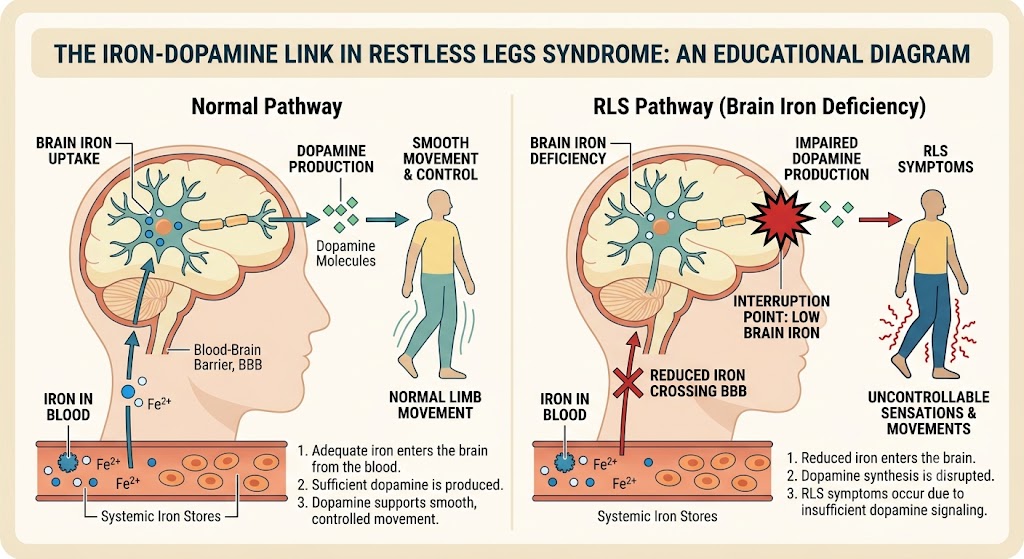
This is the heart of the topic. Iron is not just about anaemia. In the brain, iron is a building block for making dopamine, a signalling chemical that helps control smooth, coordinated movement.
Research points to a problem with iron availability in the brain specifically, even when iron levels in the blood look adequate. Brain imaging and spinal fluid studies in people with RLS have found reduced iron in the regions that regulate movement. This is why RLS is understood as a disorder of brain iron handling, not simply a shortage of iron in the body overall.
Two practical consequences follow:
- You can have RLS with a completely normal blood count and no anaemia at all.
- Raising your iron stores, even from “normal” to “comfortably above normal,” can improve symptoms because it increases the supply available to the brain.
That second point is why the target numbers for RLS are set higher than for general health.
The Numbers That Actually Matter
Here is what to understand before your appointment, because this is where care most often falls short.
Ferritin is a blood protein that reflects your iron stores. A typical lab flags “low” ferritin only when it falls below roughly 15 to 30 ng/mL, the threshold for iron deficiency in the general population. For RLS, that threshold is far too low.
| Ferritin level | What it means for RLS |
|---|---|
| At or below 75 ng/mL | Iron treatment should be considered (AASM, 2024) |
| Between 75 and 100 ng/mL | Intravenous iron may be considered; oral iron absorbs poorly in this range |
| Above 100 ng/mL, up to 300 | Iron treatment generally not indicated for RLS unless a specialist advises |
| Transferrin saturation under 20% | Supports iron treatment regardless of ferritin |
So a ferritin of, say, 45 ng/mL would be reported as perfectly normal on most lab printouts, yet it sits well within the range where iron treatment is worth considering for RLS. This gap between “normal for a lab” and “adequate for your legs” is the reason to ask directly.
One important testing detail: ferritin is also an inflammatory marker, meaning it rises during infection or inflammation and can look falsely reassuring. Iron studies should ideally be done in the morning, fasting, and not during an acute illness, and interpreted alongside transferrin saturation rather than ferritin alone.
What to Ask Your Doctor
This is the practical core of the article. Bring these requests with you.
Ask for the right tests
- “Can we check my iron studies, including ferritin and transferrin saturation, not just a full blood count?”
- “Can the test be done fasting, in the morning, since that gives the most reliable iron reading?”
- “I am not currently unwell, so inflammation should not be distorting the result. Is that right?”
Ask for your actual numbers
- “What was my exact ferritin figure?” Do not accept “normal.” A ferritin of 20 and a ferritin of 90 are both “normal” on the report but mean completely different things for RLS.
- “What was my transferrin saturation percentage?”
Ask about the RLS-specific threshold
- “My understanding is that for restless legs, iron treatment is considered when ferritin is at or below 75. Does my result fall in that range?”
Ask about treatment if your iron is low
- “If oral iron is suitable, what dose and how often should I take it, and when should we recheck?”
- “If my ferritin is between 75 and 100, or if oral iron does not work, would intravenous iron be appropriate?”
Ask what might be making it worse
- “Could any of my current medications be worsening RLS?”
- “Should I be assessed for sleep apnea, since I understand the two often occur together?”
Treating Low Iron in RLS
Oral Iron
For most people with ferritin at or below 75 ng/mL who can tolerate it, oral iron is the starting point.
How it is usually taken:
- A common regimen is around 65 mg of elemental iron (often as ferrous sulfate), taken once daily or every other day
- Taking it with vitamin C or a glass of orange juice improves absorption
- Alternate-day dosing is increasingly preferred, because taking iron every single day can actually reduce how much you absorb per dose
- Avoid taking it with tea, coffee, dairy, or calcium supplements, which block absorption
- Recheck iron studies after around three to four months
Oral iron is slow. It can take several months to raise brain iron enough to change symptoms, so patience matters. Constipation and stomach upset are common, and alternate-day dosing often helps with both.
Intravenous Iron
IV iron delivers a large dose directly into the bloodstream and bypasses the absorption problems of the gut. It is considered when:
- Ferritin sits between 75 and 100 ng/mL, where oral iron absorbs poorly
- Oral iron is not tolerated or has not worked
- A faster response is needed
- There is ongoing blood loss keeping stores low
Formulations such as ferric carboxymaltose have good evidence in RLS and can produce meaningful improvement, sometimes from a single infusion. IV iron is given under medical supervision because of a small risk of reactions.
The Safety Ceiling
Iron is not harmless in unlimited amounts. Treatment is generally not continued once ferritin rises above about 300 ng/mL, the usually accepted safe upper limit, because excess iron carries its own risks. This is also why you should not self-treat RLS with high-dose iron supplements bought over the counter. Iron overload is a real condition, and some people carry genes that make them prone to it. Test first, treat to a target, then stop.
Also Read | Gastritis Symptoms Women Over 40 Shouldn’t Ignore, From Fatigue to Stomach Pain
The Bigger Treatment Picture
Iron is the foundation, but it is not the whole story. If correcting iron does not resolve symptoms, or if symptoms are severe, other treatments come into play, and the guidance here has changed substantially.
A Major Shift Away From Dopamine Agonists
For years, dopamine agonists such as pramipexole and ropinirole were the standard first-line drugs for RLS. That has changed.
Because of a serious long-term problem called augmentation, current guidance from the American Academy of Sleep Medicine and the RLS Foundation no longer recommends dopamine agonists as first-line treatment (AASM, 2024). Instead, alpha-2-delta ligands, including gabapentin, gabapentin enacarbil, and pregabalin, are now preferred for people who need medication, because they do not cause augmentation.
If you are already taking a dopamine agonist and it is working, do not stop it on your own. But if your doctor suggests one as a new first choice, it is reasonable to ask about the alpha-2-delta ligands and the augmentation risk.
What Is Augmentation?
Augmentation is a paradoxical worsening of RLS caused by the very drugs meant to treat it, specifically dopamine agonists over time. The signs are:
- Symptoms starting earlier in the day than before
- Symptoms spreading to the arms or trunk
- Symptoms becoming more intense overall
- Each dose wearing off faster
- Symptoms getting worse when the dose is increased, which is the counterintuitive hallmark
The instinctive response, taking more of the drug, makes it worse. This is exactly why the treatment approach has moved away from these medications as a starting point.
Medications and Substances That Worsen RLS
A frequently overlooked cause of stubborn RLS is another medication making it worse. Several common drug classes can trigger or aggravate symptoms:
| Category | Examples |
|---|---|
| Antidepressants | Many SSRIs and SNRIs, and mirtazapine, which is a common offender |
| Antihistamines | Sedating types such as diphenhydramine, found in many sleep and allergy products |
| Anti-nausea drugs | Dopamine-blocking antiemetics such as metoclopramide and prochlorperazine |
| Antipsychotics | Various dopamine-blocking agents |
Do not stop a prescribed medication on your own. But if your RLS started or worsened after beginning one of these, raise it with your doctor, who may be able to adjust the timing, lower the dose, or switch you to an alternative. Sedating antihistamines in over-the-counter sleep aids are worth flagging, since people often take them precisely because RLS is wrecking their sleep, which makes the problem worse.
Lifestyle Measures That Help
These support treatment rather than replacing it, and they matter most in mild or intermittent RLS.
- Move to relieve an episode. Walking, stretching, or gently massaging the legs eases symptoms in the moment.
- Keep a regular sleep schedule. Fatigue worsens RLS, and RLS worsens sleep, so consistency helps break the loop.
- Limit caffeine, alcohol, and nicotine, particularly in the evening. Many people find alcohol a strong trigger.
- Try warm or cool applications. A warm bath or a cool pack before bed helps some people; preference varies.
- Moderate, regular exercise can reduce symptoms, though intense exercise late in the day worsens them for some.
- Address dietary iron through food, including lean red meat, legumes, and leafy greens, alongside vitamin C to aid absorption. Food alone rarely corrects an RLS-relevant deficit, but it supports the effort.
RLS in Pregnancy
RLS is the most common movement disorder in pregnancy, affecting a substantial proportion of pregnant women, with estimates commonly in the range of 15% to 30% and peaking in the third trimester. Iron demand rises sharply in pregnancy, and iron deficiency is a frequent contributor.
For most women, pregnancy-related RLS eases after delivery. Because many RLS medications are avoided in pregnancy, checking and correcting iron becomes especially important, and should be discussed with your maternity team. Do not start iron supplements in pregnancy without medical advice, as dosing needs to be individualised.
Also Read | Sickle Cell Disease: Who Is Susceptible To Sickle Cell Anaemia?
Myths vs. Facts
| Myth | Fact |
|---|---|
| Normal ferritin means iron is fine for RLS | The RLS threshold (≤75 ng/mL) is far higher than the general iron-deficiency cutoff. |
| RLS is just poor circulation or leg cramps | RLS is a neurological condition linked to brain iron and dopamine, distinct from cramps. |
| You only need iron if you are anaemic | RLS can occur with a completely normal blood count. Brain iron availability is the issue. |
| More iron is always better | Iron is stopped above about 300 ng/mL. Overload carries real risks. |
| Dopamine drugs are the best first treatment | Guidance now favours alpha-2-delta ligands first, due to augmentation risk. |
| RLS is rare and not serious | It affects up to 15% of adults and is a major cause of chronic sleep loss. |
| It is all in your head | RLS has a well-documented neurological and genetic basis. |
Common Mistakes to Avoid
- Accepting “your iron is normal” without the number. Ask for the exact ferritin and transferrin saturation.
- Testing iron during an illness. Inflammation inflates ferritin and can hide a real deficit.
- Self-treating with high-dose iron. Test first, treat to a target, and avoid overload.
- Taking iron with coffee, tea, or calcium. Absorption drops substantially.
- Taking iron every single day. Alternate-day dosing often absorbs better and is gentler on the gut.
- Ignoring a worsening pattern on dopamine drugs. Earlier, more intense, spreading symptoms may be augmentation.
- Using an over-the-counter antihistamine sleep aid. It commonly makes RLS worse.
When to See a Doctor
Book an appointment if:
- The urge to move your legs regularly disrupts your sleep
- Symptoms occur several times a week and affect daily life
- Over-the-counter measures are not helping
- Symptoms are spreading or getting more intense
- You suspect a medication may be involved
Ask specifically for: iron studies including ferritin and transferrin saturation, done fasting in the morning, with the actual numbers reported to you.
Mention promptly if:
- Symptoms began or worsened sharply after starting a new medication
- You also snore heavily or wake unrefreshed, which may point to co-existing sleep apnea
- You are pregnant and developing these symptoms
- You are on a dopamine agonist and symptoms are worsening rather than improving
One further note. Chronic sleep loss from RLS takes a real toll on mood and daytime function. If you have been feeling persistently low or exhausted, mention that too. Treating the RLS often improves both, and the low mood deserves attention in its own right.
Action Steps
- Before your appointment, note when symptoms occur, how often, and what relieves them.
- List all your medications and supplements, including over-the-counter sleep and allergy products.
- Ask for iron studies (ferritin and transferrin saturation), fasting and in the morning.
- Get your exact ferritin number, not just “normal.”
- If ferritin is at or below 75, ask about iron treatment and when to recheck.
- If you take a dopamine agonist and symptoms are worsening, ask about augmentation.
- Review whether any current medication could be contributing.
Frequently Asked Questions
My doctor said my iron is normal, so why do I still have RLS?
Standard lab ranges flag iron deficiency well below the level that matters for RLS. Iron treatment for restless legs is considered when ferritin is at or below 75 ng/mL, which most labs report as normal. Ask for your exact number.
What ferritin level is ideal for RLS?
Treatment is considered at or below 75 ng/mL. Many specialists aim to raise ferritin above 100 ng/mL to relieve symptoms, while staying below the 300 ng/mL safety ceiling.
Can I just take iron supplements to fix it?
Only after testing. Iron overload is a genuine risk, and some people are genetically prone to it. Test first, treat to a target under medical guidance, then stop.
Why alternate-day iron instead of daily?
Taking iron every day can raise a hormone called hepcidin that reduces absorption. Alternate-day dosing often improves how much you absorb per dose and is easier on the stomach.
Does RLS mean I have a serious disease?
Usually not. Most RLS is primary, often with a family history. It is sometimes linked to iron deficiency, kidney disease, pregnancy, or certain medications, which is why testing is worthwhile.
Will the iron work straight away?
Oral iron is slow and may take three to four months to change symptoms, because it has to rebuild brain iron stores. IV iron can work faster.
Can medications cause RLS?
Yes. Some antidepressants, sedating antihistamines, and anti-nausea drugs can trigger or worsen it. Never stop a prescribed drug on your own, but do raise the timing with your doctor.
Is RLS linked to sleep apnea?
The two frequently co-occur, and untreated sleep apnea makes RLS harder to control. If you snore or wake unrefreshed, ask to be assessed.
Key Takeaways
- Iron is the first thing to check in RLS, and the RLS threshold is much higher than for ordinary iron deficiency.
- Iron treatment is considered when ferritin is at or below 75 ng/mL, or transferrin saturation is under 20% (AASM, 2024).
- “Normal” ferritin on a lab report can still be too low for your legs. Always ask for the exact number.
- Iron studies should be done fasting, in the morning, and not during an illness.
- Oral iron suits most people; IV iron is used when ferritin is 75 to 100, when oral iron fails, or when a faster response is needed.
- Dopamine agonists are no longer first-line, because of augmentation. Alpha-2-delta ligands are now preferred when medication is needed.
- Several common medications, including some antidepressants and sedating antihistamines, worsen RLS.
The Bottom Line
Restless legs syndrome is common, disruptive, and often very treatable, and iron is where treatment starts. The most useful thing you can do is walk into your appointment knowing that the iron level relevant to your legs is higher than the level a lab flags as low.
Ask for iron studies, get your exact ferritin and transferrin saturation numbers, and ask directly whether they fall at or below the RLS threshold of 75. If they do, correcting iron may ease or resolve your symptoms without anything more. If it does not, effective further options exist, and the treatment approach has improved considerably in recent years.
You do not have to accept sleepless, restless nights as simply your lot. A single blood test, correctly interpreted, is often the turning point.
Also Read | Why Do I Sweat So Much After 50? Causes and Fixes
References
Allen, R. P., Picchietti, D. L., Auerbach, M., Cho, Y. W., Connor, J. R., Earley, C. J., Garcia-Borreguero, D., Kotagal, S., Manconi, M., Ondo, W., Ulfberg, J., & Winkelman, J. W. (2018). Evidence-based and consensus clinical practice guidelines for the iron treatment of restless legs syndrome/Willis-Ekbom disease in adults and children: An IRLSSG task force report. Sleep Medicine, 41, 27–44. https://doi.org/10.1016/j.sleep.2017.11.1126
American Academy of Sleep Medicine. (2024). Treatment of restless legs syndrome and periodic limb movement disorder: An American Academy of Sleep Medicine clinical practice guideline. Journal of Clinical Sleep Medicine. https://aasm.org/clinical-resources/practice-standards/practice-guidelines/
Cleveland Clinic. (n.d.). Restless legs syndrome. https://my.clevelandclinic.org/health/diseases/9497-restless-legs-syndrome
Gonzalez-Latapi, P., & Malkani, R. (2019). Update on restless legs syndrome: From mechanisms to treatment. Current Neurology and Neuroscience Reports, 19(8), 54. https://doi.org/10.1007/s11910-019-0965-4
Mayo Clinic. (n.d.). Restless legs syndrome: Symptoms and causes. https://www.mayoclinic.org/diseases-conditions/restless-legs-syndrome/symptoms-causes/syc-20377168
National Health Service. (2024). Restless legs syndrome. https://www.nhs.uk/conditions/restless-legs-syndrome/
National Institute of Neurological Disorders and Stroke. (2024). Restless legs syndrome. https://www.ninds.nih.gov/health-information/disorders/restless-legs-syndrome
Silber, M. H., Buchfuhrer, M. J., Earley, C. J., Koo, B. B., Manconi, M., & Winkelman, J. W. (2021). The management of restless legs syndrome: An updated algorithm. Mayo Clinic Proceedings, 96(7), 1921–1937. https://doi.org/10.1016/j.mayocp.2020.12.026
Yale Medicine. (2024). Do you have restless legs syndrome (RLS)? Treatment advice has changed. https://www.yalemedicine.org/news/restless-legs-syndrome-advice-has-changed