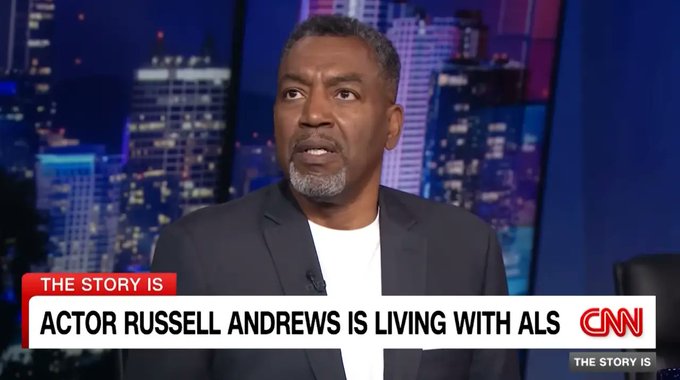

In a moving and candid public announcement during ALS Awareness Month, actor and director Russell Andrews has opened up about his recent diagnosis with amyotrophic lateral sclerosis (ALS). Standing alongside his longtime partner, actress Erica Tazel, Andrews used his platform not just to share his personal story but to spotlight the daily realities of ALS for patients, caregivers, and families across the United States.
What has struck fans and advocates alike is the quiet strength of the couple’s bond: Tazel has transitioned from fiancée to hands‑on caregiver, yet insists that her deepest desire remains unchanged; she still wants to be his wife. Their story is now interwoven with the broader ALS advocacy conversation, as Andrews collaborates with the ALS Network to connect other families with resources and community support.
Russell Andrews Reveals ALS Diagnosis in Emotional Public Announcement
Russell Andrews shared his diagnosis in the fall of 2025, but it was in May 2026 that he brought it into the public eye with a series of interviews and a partnership with the ALS Network. On “The Story” and in media appearances, he described how early symptoms—twitching, unexplained weakness, and the loss of simple motor skills—led him to seek medical help after regaining health insurance following the 2023 actors’ strike.
His public statement emphasized both vulnerability and resolve. He acknowledged the fear of ALS, a progressive neurodegenerative disease that affects nerve cells in the brain and spinal cord, but also highlighted the importance of early awareness and community support. Statistics show that ALS affects roughly 33,000 people in the U.S., with projections of more than 36,000 cases by 2030, underscoring why high‑profile advocacy like Andrews’ can help shift public attention toward research and care.
Who Is Actor Russell Andrews? Career Highlights from Better Call Saul to Insecure
Born in Houston and raised in a theater‑rich environment, Russell Andrews built a career that spans stage, television, and film. Over nearly 25 years he has performed in landmark productions of August Wilson’s plays, including “Ma Rainey’s Black Bottom,” “Jitney,” and “The Piano Lesson,” earning multiple Los Angeles theater awards and an NAACP Theatre Award for Best Actor.
His screen work includes roles in AMC’s “Better Call Saul,” where he appeared in a memorable episode as a district attorney, and HBO’s “Insecure,” where he played Vice Principal Charles Gaines. He also received an Emmy consideration in 2016 for his performance in “Runaway Island” on TV One, cementing his reputation as a nuanced character actor who often brings quiet authority to the screen.
Beyond acting, Andrews is the founding member and Producing Artistic Director of StageWalkers Productions in Los Angeles, a company that has won multiple LA Theatre awards and Ovation Awards, often spotlighting African American stories and voices.
Russell Andrews ALS Diagnosis: Timeline and First Symptoms
Andrews has been open about the timeline of his illness. In interviews, he has said he was first diagnosed in the late fall of 2025, after a period of confusing physical changes that began during the 2020–2023 pandemic and work suspensions in the industry. Early on, he experienced “twitches” and intermittent weakness in his arms, which he initially brushed off as pinched nerves or stress‑related ailments.
Over time, those subtle signs became harder to ignore. He described losing the ability to do routine tasks, such as holding cups and glasses without dropping them, and feeling as though “things were running up and down” his limbs. Tazel noticed small changes in his gait and in how he moved, especially when doing simple chores like cleaning the pool.
Once he regained health insurance, he saw a primary‑care physician, who referred him to a neurologist within minutes. ALS diagnosis is notoriously complex because there is no single definitive test; it usually involves a combination of physical exams, nerve‑conduction studies, and imaging of the brain and spinal cord.
Erica Tazel’s Heartbreaking Response: “I Still Want to Be Your Wife”
Erica Tazel, known for her role on FX’s “Justified,” has become one of the most visible faces of caregiver resilience in Andrews’ journey. In interviews, she has spoken candidly about the emotional toll of watching her partner lose motor function, while still insisting that their love hasn’t diminished.
Her most poignant line so far has been: “I still want to be your wife.” That statement captures not romantic idealism, but a practical commitment to partnership in the face of a disease that can isolate patients and strain relationships.
Tazel’s shift from life partner to caregiver is both physical and emotional. She helps manage daily routines, medications, and medical appointments, while also serving as a public advocate by sharing their story with outlets like CNN and mainstream magazines. Her voice amplifies the often‑overlooked role of caregivers in the ALS community, many of whom juggle work, family, and their own mental‑health needs.
Russell Andrews and Erica Tazel Love Story: Fiancée‑Turned‑Caregiver
Andrews and Tazel first met through the entertainment industry, bonding over shared creative passions and a deep appreciation for storytelling on both stage and screen. Their relationship evolved over years of collaboration and life milestones, including working on projects like “Runaway Island,” where they appeared together on screen.
Their engagement came at a time when Andrews’ career was still active and relatively stable. Then the actors’ strike and pandemic layoffs disrupted work, followed by the onset of his ALS symptoms. In that compressed, uncertain period, Tazel’s role shifted from fiancée to full‑time caregiver, a transition she has described as both painful and necessary.
What makes their story stand out is not just the seriousness of the diagnosis, but the way they continue to frame their relationship as a team. They speak of planning as a unit, of sharing hopes for their daughter’s future, and of finding meaning in small moments, such as watching a movie together or sharing a meal.
The Couple’s Daughter Anya and Family Support Amid ALS Battle
At the center of their fight against ALS is their daughter, Anya, whose presence has become a driving force in both Russell’s and Erica’s resilience. Although details about her age and background are kept relatively private, public statements and media coverage suggest that family life now revolves around ensuring Anya feels secure, loved, and not overwhelmed by the weight of her father’s illness.
Extended family and close friends have also formed a support network, helping with logistics, emotional encouragement, and sometimes direct caregiving so that Tazel can take breaks. This kind of ecosystem is especially important because ALS can be physically exhausting for both patient and caregiver; guidelines from organizations like the ALS Association and the Mayo Clinic stress the need for respite care and community‑based support.
The couple’s partnership with the ALS Network aims to connect other families to similar resources, including counseling, equipment assistance (such as wheelchairs and communication devices), and local caregiver‑support groups.
How ALS Has Changed Russell Andrews’ Life and Outlook
ALS has reshaped nearly every aspect of Russell Andrews’ daily life. As the disease progresses, it gradually erodes voluntary muscle control, often starting in the limbs and then affecting speech, swallowing, and eventually breathing. Medical experts note that most people live between two and five years after diagnosis, although about 20 percent survive longer.
For Andrews, that prediction is not a reason to withdraw, but a catalyst for advocacy. He has said that sharing his experience is a way to honor others who battle ALS in silence and to pressure institutions to invest more in research and accessible care.
At the same time, the disease has deepened his perspective on relationships and purpose. He reflects on the importance of presence, being emotionally available for his daughter, leaning on his partner, and continuing creative work where possible instead of focusing solely on what he can no longer do physically.
What Russell Andrews’ Story Tells Us About ALS and Caregiving
The public emergence of Russell Andrews’ ALS journey offers several important lessons. First, early symptoms of ALS can be subtle, such as twitching, weakness, and loss of fine motor control, so awareness of these signs can help people seek help sooner. Second, having a supportive partner or caregiver can significantly improve quality of life for someone living with ALS, even though the emotional and physical burden on that caregiver is often immense.
Finally, Andrews’ partnership with the ALS Network underscores how public figures can help destigmatize neurodegenerative diseases, normalize difficult conversations, and connect families with real‑world resources. His story, framed by Erica Tazel’s steadfast love and the quiet resilience of their daughter, Anya, turns a painful diagnosis into a call for compassion, community, and continued research.
Also Read | Martha Stewart’s Secret to Feeling Fabulous at 84: Self-Care Routine Revealed