Sound health and lasting wealth
  • Home
  • Health
    • Children’s Health
    • Men’s Health
    • Women’s Health
  • Diseases
  • Health News
    • COVID-19
  • Nutrition
  • Food
  • For you
    • People
    • Shalw Gist
    • Celebrity Healtth
  • Advertise Here
Sound health and lasting wealth
  • Home
  • Health
    • Children’s Health
    • Men’s Health
    • Women’s Health
  • Diseases
  • Health News
    • COVID-19
  • Nutrition
  • Food
  • For you
    • People
    • Shalw Gist
    • Celebrity Healtth
  • Advertise Here
  • Diseases

Sex During the Coronavirus (COVID-19 ): What You Need to Know for Safer Intimacy

  • One comment
Total
0
Shares
Share 0
Tweet 0
Pin it 0
Sex During the Coronavirus (COVID-19 ): What You Need to Know for Safer Intimacy
Up next
Hantavirus: causes, symptoms and treatments
What is Hantavirus – Causes, Symptoms and Treatments?
Published on 24 March 2020Updated on 26 June 2024
Author
shalw
Tags
  • coronavirus outbreak,
  • Diseases & Conditions,
  • Love and relationships,
  • Sex & Relationships,
  • Sex Guide,
  • Sex tips
Share article
The post has been shared by 0 people.
Facebook 0
X (Twitter) 0
Pinterest 0
Mail 0
Physical or social distancing is a critical measure to slow the spread of COVID-19, but it poses unique challenges for couples who share living spaces. When in close proximity, sexual intimacy can become difficult to avoid. Then there comes the concern Is sex during the COVID-19 coronavirus safe? What are the risks associated with intimacy at this difficult time? When Is It safe to have sex after COVID?

To navigate intimacy safely during the COVID-19 pandemic, it’s crucial to understand how the virus spreads and take appropriate precautions. The SARS-CoV-2 virus, which causes COVID-19, is primarily transmitted through respiratory droplets produced when an infected person coughs, sneezes or even speaks. These droplets can linger in the air for a short time, posing a risk when individuals are in close proximity.

Respiratory droplets are relatively large particles that typically fall to the ground within a few feet of the source. However, in certain situations, such as when an infected person is coughing or sneezing forcefully, the droplets can travel further. This is why maintaining a safe distance of at least 6 feet (2 meters) from others is recommended to reduce the risk of exposure.

In addition to airborne transmission, the virus can also survive on various surfaces for varying periods. The exact duration depends on factors such as the type of surface and environmental conditions. While surface transmission is not considered the main route of COVID-19 spread, it’s essential to practice good hand hygiene by regularly washing hands with soap and water or using an alcohol-based hand sanitizer.

Can COVID-19 Be Transmitted Sexually?

While COVID-19 is primarily spread through respiratory droplets, there is some evidence that the virus may be able to transmit through sexual contact:

Limited research studies detected SARS-CoV-2, the virus that causes COVID-19, in the semen and vaginal fluids of some infected individuals. However, it’s unclear if the presence of the virus in these bodily fluids leads to sexual transmission.

Viral particles may potentially be transmitted through oral sex and the use of saliva as a lubricant, as the virus can be shed through saliva and feces. The virus may also be transmitted through anal sex, as ACE2 receptors (which the virus uses to infect cells) are expressed in the rectum.

One Research by Journal of Sex & Marital Therapy found that most men recovering from COVID-19 had SARS-CoV-2 in their semen. However, the Archives of Sexual Behavior Journal did not detect SARS-CoV-2 either in semen or in vaginal fluids of positive cases.

Theoretically, the virus could be transmitted through sharing sex toys or during any intimate contact that exposes partners to infectious bodily fluids. However, there is no concrete evidence that this occurs.

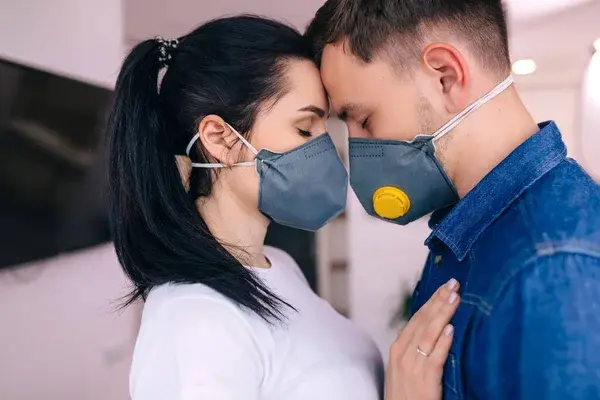
Now, if you’re wondering how to navigate intimate relationships while minimizing health risks, experts recommend avoiding intimate contact if either partner has COVID-19 symptoms or has been exposed to the virus. If both partners are healthy, the risk can be reduced by:

  • Avoiding kissing and other forms of face-to-face contact.
  • Using barriers like condoms and dental dams to reduce exposure to bodily fluids
  • Washing hands and cleaning high-touch surfaces before and after intimate contact.
  • This restriction should continue until you/your partner are clear of the symptoms.

By understanding how COVID-19 spreads and taking proactive steps to mitigate risks, couples can navigate intimacy more safely during these challenging times.


Safer Options for Uninfected Couples

Sexual restrictions around COVID-19 do not apply to couples who are both free of symptoms and have not been exposed to the virus. Engaging in sexual activities can be a way to stay connected and relieve stress during this challenging time. Some safer options include sex with partners only, indoors or out, sex outdoors or in well-ventilated spaces, and virtual sex,  sex talk, and porn while alone or with a partner.

Extra Resources 

  • https://coronavirus.dc.gov/sex
  • https://onlinelibrary.wiley.com/doi/full/10.1002/iid3.971
  • https://www.scientificamerican.com/article/when-is-it-safe-to-have-sex-after-covid/
  • https://www.cdc.gov/coronavirus/2019-ncov/more/science-and-research/surface-transmission.html


Soundhealthandlastingwealth.com offer the most up-to-date information from top experts, new research, and health agencies, but our content is not meant to be a substitute for professional guidance. When it comes to the medication you're taking or any other health questions you have, always consult your healthcare provider directly.
Leave a Reply Cancel reply

Your email address will not be published. Required fields are marked *

You May Also Like
10 Causes of Lung Cancer in Non-Smokers
  • Diseases

10 Causes of Lung Cancer In Non-Smokers

10 Causes Lung Cancer in Non-Smokers – While smoking remains the primary…
  • shalw
  • December 31, 2023
  • Diseases

5 best energy and immune boosting foods to eat during Navratri fasting

Navaratri is a popular Hindu festival that spans nine nights (and ten…
  • shalw
  • March 25, 2020
10 Blood Type O Skin Problems That Are Peculiar 
  • Diseases

10 Blood Type O Skin Problems That Are Peculiar 

Are you a blood type O individual? Do you often face skin problems and don’t know why? Well, your blood type may be the culprit.
  • shalw
  • March 31, 2023
10 Best Dry Cough Medicines Or Syrups For Adults And Children
  • Diseases

10 Best Dry Cough Medicines Or Syrups For Adults And Children

A cough may be inevitable for most people as it’s the body’s…
  • shalw
  • May 14, 2020
Recent Posts
  • Is Hantavirus the Next Threat? Tenerife Ship Outbreak Explained
  • 9 Surprising Health Traits You Got from Mom
  • Vagus Nerve Reset Calms Stress in 60 Seconds—Stanford Doctor Confirms
  • Hantavirus Outbreak: How WHO Handles MV Hondius Crisis in Tenerife
  • Vaginal Microbiome Test Solves Mystery Pelvic Pain Doctors Missed for Months
  • Kayla Itsines Engaged To Partner Jae Woodroffe: Who Is He? Net Worth & Photos On Instagram
  • Who Is Mike Trizano Wife Amber Miller Trizano? Married Life Explored
  • Is Davante Adams Hair Real? Long Hairstyle – How Did He Grow His Hair?
  • How to Prevent and Reduce Uterine Fibroids After Menopause
  • Softmadeit Slaps Girlfriend – Who Is Beauty Goddess on TikTok? Net Worth And Age Difference

May 2026
MTWTFSS
 123
45678910
11121314151617
18192021222324
25262728293031
« Apr    
Is Hantavirus the Next Threat? Tenerife Ship Outbreak Explained
  • Health News

Is Hantavirus the Next Threat? Tenerife Ship Outbreak Explained

A rare hantavirus outbreak on the luxury cruise ship MV Hondius has…
  • shalw
  • May 12, 2026
9 Surprising Health Traits You Got from Mom
  • Women's Health

9 Surprising Health Traits You Got from Mom

What we inherit from our moms shapes our lives in ways we…
  • shalw
  • May 12, 2026
Vagus Nerve Reset Calms Stress in 60 Seconds—Stanford Doctor Confirms
  • Health

Vagus Nerve Reset Calms Stress in 60 Seconds—Stanford Doctor Confirms

How a vagus nerve reset calms stress in just 60 seconds, backed…
  • shalw
  • May 11, 2026
Hantavirus Outbreak: How WHO Handles MV Hondius Crisis in Tenerife
  • Health

Hantavirus Outbreak: How WHO Handles MV Hondius Crisis in Tenerife

The MV Hondius cruise ship arrived off Tenerife in Spain’s Canary Islands,…
  • shalw
  • May 11, 2026
Sound health and lasting wealth
  • Editorial Guidelines
  • DMCA Notice
  • Advertise Here
  • Sitemap
  • Contact
pixel