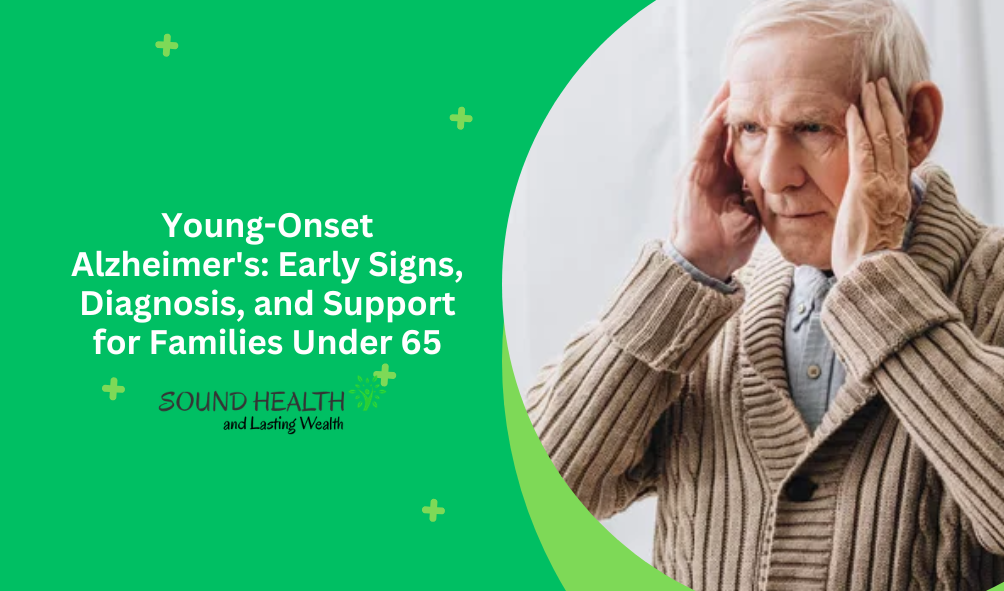

Alzheimer’s disease is not only a condition of old age. When it develops before the age of 65, it is called young-onset (or early-onset) Alzheimer’s, and an estimated 200,000 people in the United States are living with younger-onset dementia (Alzheimer’s Association, 2024).
The people affected are often in their 40s and 50s, in the middle of careers, raising children, or caring for their own parents. Because doctors rarely expect Alzheimer’s in someone this young, getting a diagnosis can be a long, frustrating process, and early symptoms are often blamed on stress, depression, or menopause (Alzheimer’s Association, 2024).
This article explains the early signs to watch for, how young-onset Alzheimer’s is diagnosed, and where families can find real support. It is written to help people navigate an isolating diagnosis, not to alarm anyone experiencing ordinary forgetfulness.

What you will learn:
- What young-onset Alzheimer’s is and how common it is
- The early warning signs, and how they differ from normal ageing
- Why diagnosis is often delayed, and how to push for answers
- The role of genetics
- Practical and emotional support for families
Also Read | Insomnia Relief Found: One Woman’s Red Light Therapy Success Story
What Is Young-Onset Alzheimer’s?
Alzheimer’s disease is the most common cause of dementia, a progressive decline in memory, thinking, and reasoning severe enough to affect daily life. It is called young-onset or early-onset when symptoms begin before age 65 (Alzheimer’s Association, 2024).
A crucial point to hold onto: Alzheimer’s is not a normal part of ageing, and forgetfulness is not the same as dementia. Everyone misplaces keys or forgets a name occasionally. Alzheimer’s involves a persistent, worsening pattern of cognitive change that interferes with everyday functioning.
Most people with young-onset Alzheimer’s have the sporadic form, the same common type seen in older adults, not an inherited one. Doctors do not fully understand why it appears earlier in these individuals (Alzheimer’s Association, 2024).
How Common Is It?
Because research on younger-onset dementia is limited, prevalence figures are estimates rather than precise counts.
- Researchers believe about 110 of every 100,000 people aged 30 to 64 have younger-onset dementia, roughly 200,000 people in the US (Alzheimer’s Association, 2024).
- Globally, a population study estimated 7.75 million cases of early-onset Alzheimer’s and related dementias among adults aged 40 to 64 in 2021, up from 3.67 million in 1990 (Zhang et al., 2025).
- That same global analysis found early-onset cases were more common in women than men (Zhang et al., 2025).
These numbers are small compared with Alzheimer’s in older adults, but they represent a group whose needs are very different, because they are diagnosed in the prime of working and family life.
Early Warning Signs to Watch For
Young-onset Alzheimer’s can begin subtly, and the signs are easy to dismiss or misattribute. The Alzheimer’s Association describes a set of common warning signs that apply across ages. In younger people, they often first show up at work or in complex daily tasks.
1. Memory Loss That Disrupts Daily Life
Forgetting recently learned information, important dates, or events; asking the same questions repeatedly; relying heavily on notes or family members for things once handled easily. Occasionally forgetting a name and remembering it later is normal. A persistent pattern is not.
2. Difficulty With Planning or Problem-Solving
Trouble following a familiar recipe, managing monthly bills, or concentrating on detailed tasks. Work performance may slip in ways that feel out of character.
3. Trouble Completing Familiar Tasks
Struggling with routines that were once automatic, such as driving to a familiar place, organising a shopping list, or operating a familiar device.
4. Confusion With Time or Place
Losing track of dates, seasons, or the passage of time. Sometimes forgetting where they are or how they got there.
5. Problems With Words in Speaking or Writing
Trouble following or joining a conversation, stopping mid-sentence, struggling to find the right word, or calling things by the wrong name.
6. Misplacing Things and Losing the Ability to Retrace Steps
Putting things in unusual places and being unable to work backwards to find them, sometimes leading to accusations that others have stolen items.
7. Changes in Mood, Personality, or Judgment
Becoming confused, suspicious, anxious, or withdrawn; showing poorer judgment with money or decisions; losing interest in work and social activities. In younger people these changes are frequently mistaken for depression, burnout, or a midlife crisis.
8. Withdrawal From Work or Social Life
Pulling back from hobbies, projects, or social plans, sometimes because it has become hard to keep up and the person is trying to hide the difficulty.
An important note: any one of these can have many causes, including stress, thyroid problems, vitamin deficiencies, sleep disorders, medication side effects, and depression, many of which are treatable and reversible. That is exactly why a proper assessment matters, rather than assuming the worst or ignoring it.
Also Read | Erectile Dysfunction Drugs Show Promise in Reducing Alzheimer’s Risk
Normal Ageing vs. Warning Signs
| Typical age-related change | Possible warning sign |
|---|---|
| Forgetting a name, remembering it later | Forgetting recently learned information repeatedly |
| Occasionally needing help with a device setting | Being unable to manage familiar tasks or routines |
| Making an occasional error in the chequebook | Losing the ability to manage finances or follow a plan |
| Briefly forgetting the day, realising it soon | Losing track of dates, seasons, or where you are |
| Sometimes searching for a word | Frequently stopping mid-sentence or substituting wrong words |
| Misplacing keys and retracing steps to find them | Putting items in odd places and being unable to retrace |
| Feeling weary of obligations | Withdrawing from work and social life due to difficulty |
Why Diagnosis Is Often Delayed
For younger people, getting to an accurate diagnosis can be a long and disheartening journey, and understanding why helps families advocate more effectively.
- Clinicians do not expect it. Health professionals generally do not look for Alzheimer’s in someone in their 40s or 50s, so symptoms may be attributed to stress, anxiety, or depression first (Alzheimer’s Association, 2024).
- Symptoms overlap with common conditions. Fatigue, low mood, brain fog, and forgetfulness fit many diagnoses, including menopause, thyroid disease, and burnout.
- Conflicting opinions are common. People may receive different explanations from different professionals before dementia is considered (Alzheimer’s Association, 2024).
- The person may hide it. Younger adults often work hard to mask difficulties at work and home, which delays recognition.
If you or a loved one has persistent, worsening cognitive changes that are not explained by another cause, it is reasonable to ask specifically for a referral to a neurologist or a memory clinic. Persistence is often necessary, and it is not rude to seek a second opinion.
How Young-Onset Alzheimer’s Is Diagnosed
There is no single test. Diagnosis is a process of careful assessment and ruling out other causes.
| Step | What it involves |
|---|---|
| Detailed history | Symptoms, timeline, family history, and input from someone close to the person |
| Cognitive testing | Standardised tests of memory, language, attention, and problem-solving |
| Physical and neurological exam | Checking for other explanations and neurological signs |
| Blood tests | Ruling out thyroid problems, vitamin deficiencies, infection, and other reversible causes |
| Brain imaging | MRI or CT to assess brain structure and exclude other conditions; specialised scans in some cases |
| Specialist referral | Neurologist, memory clinic, or a centre with young-onset expertise |
Newer diagnostic tools, including certain biomarker tests, are increasingly used in specialist settings to support a diagnosis. Because young-onset cases can be atypical and complex, referral to a centre experienced in early-onset dementia is often valuable.
The purpose of a thorough workup is twofold: to confirm Alzheimer’s where it is present, and, just as importantly, to catch treatable conditions that can mimic it. Some causes of cognitive change are fully reversible when identified.
Also Read | Stop Post-Meal Glucose Spikes: Protect Brain From Alzheimer’s
The Role of Genetics
Families understandably worry about whether the condition is inherited. Here is what the evidence shows.
- Most young-onset Alzheimer’s is sporadic, meaning it is not caused by a single inherited gene, and having a parent with it does not mean you will develop it (Alzheimer’s Association, 2024).
- A small minority of cases are caused by rare inherited gene mutations (in genes such as APP, PSEN1, and PSEN2). Across all Alzheimer’s, an estimated 1% or less is caused by these deterministic mutations (Alzheimer’s Association, 2024).
- Other genes, such as certain variants of APOE, can increase risk without guaranteeing the disease.
If there is a strong family history of dementia occurring at young ages across generations, genetic counselling can help a family understand their situation and options. Genetic testing is a significant personal decision and is best approached with professional guidance, not undertaken alone.
Living With the Diagnosis: Practical Support
A young-onset diagnosis brings challenges older-onset patients may not face: careers cut short, dependent children, mortgages, and a healthcare and benefits system largely designed around older people. Practical planning matters.
Early practical steps many families find helpful:
- Legal and financial planning while the person can participate fully, including power of attorney, wills, and advance care planning
- Workplace conversations about rights, adjustments, and options; many regions have disability protections
- Benefits and financial advice, since young-onset can affect income during peak earning years
- A care navigator or social worker, who can help coordinate services that are often fragmented
- Practical aids such as calendars, reminders, labelled items, and simplified routines
Planning early is not giving up. It is one of the most protective things a family can do, because it lets the person shape decisions about their own future while they are best able to.
Emotional Support for the Whole Family
The emotional weight falls on everyone, including partners, children, and the person themselves.
- For the person diagnosed: a diagnosis does not erase who someone is. Many people live meaningfully for years, and connecting with others facing young-onset can ease the isolation that this diagnosis so often brings.
- For partners and spouses: roles shift, sometimes quickly. Support for caregivers is not a luxury; it protects the caregiver’s own health.
- For children and teenagers: having a parent with young-onset dementia is uniquely hard, and age-appropriate support and honest, gentle communication help.
- For everyone: grief can begin long before the end of life, a phenomenon sometimes called anticipatory grief. It is a normal response and deserves support.
Isolation is one of the most commonly reported burdens of a young-onset diagnosis, precisely because so few people in the person’s age group are going through it. Peer support, whether in person or online, addresses that directly.
Where to Find Help
Reliable organisations offer information, helplines, and support specifically for younger-onset dementia:
- Alzheimer’s Association (US), including a 24/7 helpline and younger-onset resources
- Alzheimer’s Society (UK) and Dementia UK, including Admiral Nurses for family support
- Alzheimer Society of Canada and its provincial societies
- National Institute on Aging (NIH), for research-based information
- Local memory clinics and dementia charities, which can connect families to nearby services
If you are struggling to get answers from your regular doctor, these organisations can also help you understand what to ask for and how to seek specialist assessment.
Also Read | Thyroid condition: disorders, causes, symptoms, diagnosis and treatment
Myths vs. Facts
| Myth | Fact |
|---|---|
| Alzheimer’s only affects older people | It can develop before 65; about 200,000 Americans have younger-onset dementia. |
| Forgetfulness always means Alzheimer’s | Many causes of memory change are treatable and reversible; assessment is essential. |
| A diagnosis means life is over | Many people live meaningfully for years; planning and support make a real difference. |
| Young-onset is always inherited | Most cases are sporadic, not caused by a single inherited gene. |
| Nothing can be done | While there is no cure, support, planning, and some treatments can improve quality of life. |
| Symptoms in your 40s are just stress | Stress can cause them, but persistent, worsening changes deserve proper evaluation. |
Common Mistakes to Avoid
- Dismissing persistent symptoms as stress or menopause. Get a proper assessment rather than guessing.
- Assuming the worst without evaluation. Many causes of cognitive change are treatable.
- Delaying legal and financial planning. Doing it early protects the person’s own wishes.
- Trying to cope alone. Support organisations exist specifically for this, and isolation makes everything harder.
- Accepting a single dismissive opinion. Seeking a second opinion or specialist referral is reasonable.
- Overlooking the caregiver’s health. Caregiver wellbeing is essential, not optional.
When to See a Doctor
Make an appointment if you or someone close to you has:
- Memory or thinking changes that are persistent and worsening, not occasional
- Difficulty with familiar tasks, planning, or managing finances
- Getting lost in familiar places or confusion about time
- Word-finding problems that disrupt conversation
- Personality or mood changes that are out of character
- Symptoms that are affecting work or relationships
Ask specifically about a referral to a neurologist or memory clinic if concerns persist, particularly if a regular doctor attributes everything to stress without assessment.
If cognitive changes come alongside persistent low mood, hopelessness, or thoughts of not wanting to go on, please treat that as a reason to seek help promptly and to mention it directly to a professional. Depression is common, treatable, and can itself affect memory and concentration.
Action Steps
- Write down the specific changes you have noticed, with rough dates.
- Bring someone who knows you well to appointments; their observations help.
- Ask directly for cognitive assessment and, if needed, a specialist referral.
- Request blood tests to rule out treatable causes such as thyroid and vitamin issues.
- Contact a dementia organisation early for guidance and support.
- If a diagnosis is confirmed, begin legal and financial planning while the person can participate.
- Arrange support for caregivers and children, not only the person diagnosed.
Frequently Asked Questions
What is young-onset Alzheimer’s?
It is Alzheimer’s disease that develops before the age of 65. Many affected people are in their 40s and 50s, often still working and raising families.
How common is it?
Estimates suggest about 200,000 people in the US have younger-onset dementia, though prevalence data is limited. Globally, early-onset cases number in the millions.
What are the earliest signs?
Persistent memory loss that disrupts daily life, difficulty with planning or familiar tasks, confusion with time or place, word-finding problems, and out-of-character mood or personality changes.
Is it inherited?
Most cases are sporadic and not caused by a single inherited gene. A small minority are caused by rare gene mutations. Genetic counselling can help families with a strong history of young-onset dementia.
Why is it so hard to diagnose?
Doctors do not usually expect Alzheimer’s in younger people, and symptoms overlap with stress, depression, thyroid problems, and menopause. Diagnosis often takes persistence and specialist referral.
Can anything be done after diagnosis?
There is no cure, but support, planning, some treatments, and connection with others can meaningfully improve quality of life. Early planning helps the person shape their own future.
What should I do if I am worried about a loved one?
Note the specific changes, encourage a medical assessment, and ask for a referral to a memory clinic or neurologist if concerns persist. Contact a dementia organisation for guidance.
Where can families get support?
The Alzheimer’s Association, Alzheimer’s Society, Dementia UK, the Alzheimer Society of Canada, and the National Institute on Aging all offer information and support, including resources specific to younger-onset.
Key Takeaways
- Young-onset (early-onset) Alzheimer’s develops before 65, affecting an estimated 200,000 people in the US, often in their 40s and 50s.
- Alzheimer’s is not a normal part of ageing, and ordinary forgetfulness is not the same as dementia.
- Early signs include disruptive memory loss, difficulty with planning and familiar tasks, confusion with time or place, word-finding problems, and personality changes.
- Diagnosis is often delayed because clinicians do not expect it in younger people; persistence and specialist referral help.
- Most cases are sporadic, not inherited; a small minority are caused by rare gene mutations.
- Many treatable conditions mimic dementia, so proper assessment matters.
- Early legal, financial, and emotional planning protects the person’s wishes and supports the whole family.
The Bottom Line
Young-onset Alzheimer’s is uncommon, but for the families living with it, the impact is profound, precisely because it arrives during the busiest, most demanding years of life. The diagnosis is often slow and frustrating to reach, and the isolation of facing a condition that few peers understand is one of its heaviest burdens.
If you are worried about persistent, worsening cognitive changes in yourself or someone you love, the most useful step is a proper medical assessment, both to identify Alzheimer’s if it is present and to catch the many treatable conditions that can look like it. Do not accept a dismissive answer if your concerns persist. Ask for a referral.
A diagnosis, if it comes, does not erase the person or end their story. With the right support, planning, and connection, families can face it with more steadiness than they might expect. And no one should have to face it alone; the organisations listed here exist for exactly this reason.
Also Read | Endocrinologists’ Secrets About Menopause, Thyroid Health, and Women’s Weight Loss
References
Alzheimer’s Association. (2024). 2024 Alzheimer’s disease facts and figures. Alzheimer’s & Dementia, 20(5). https://www.alz.org/alzheimers-dementia/facts-figures
Alzheimer’s Association. (n.d.). Younger/early-onset Alzheimer’s. https://www.alz.org/alzheimers-dementia/what-is-alzheimers/younger-early-onset
Alzheimer’s Association. (n.d.). 10 early signs and symptoms of Alzheimer’s and dementia. https://www.alz.org/alzheimers-dementia/10_signs
National Institute on Aging. (2024). What is Alzheimer’s disease? https://www.nia.nih.gov/health/alzheimers-and-dementia/what-alzheimers-disease
National Institute on Aging. (2023). Younger/early-onset Alzheimer’s disease. https://www.nia.nih.gov/health/alzheimers-symptoms-and-diagnosis
Zhang, Z., Han, S., Zhu, H., Wang, Q., Cheng, S., Han, Y., Li, F., & Guo, J. (2025). Global, regional, and national burden of early-onset Alzheimer’s disease and other dementias in young adults aged 40 to 64 years, 1990 to 2021: A population-based study. European Journal of Neurology, 32(3). https://doi.org/10.1111/ene.70116
World Health Organization. (2023). Dementia. https://www.who.int/news-room/fact-sheets/detail/dementia
Mayo Clinic. (2024). Early-onset Alzheimer’s: When symptoms begin before 65. https://www.mayoclinic.org/diseases-conditions/alzheimers-disease/in-depth/alzheimers/art-20048356