- The vagus nerve is the main nerve of the parasympathetic (calming) nervous system, and slow breathing increases its activity, which is why it helps you feel calmer.
- A large 2022 review of 223 studies found that voluntary slow breathing reliably increases vagally-mediated heart rate variability, a standard marker of parasympathetic activity.
- A 2023 Stanford randomized trial found that five minutes a day of exhale-focused “cyclic sighing” improved mood and lowered breathing rate more than mindfulness meditation over one month.
- Techniques that emphasize a longer exhale than inhale appear especially effective for reducing stress and anxiety.
- Gentle slow breathing is very safe for most people, but intense breathwork involving forceful breathing or long breath holds carries real risks and should never be done near water or while driving.
- Breathing exercises support stress management, but they are not a substitute for professional care when anxiety or low mood is persistent or severe.
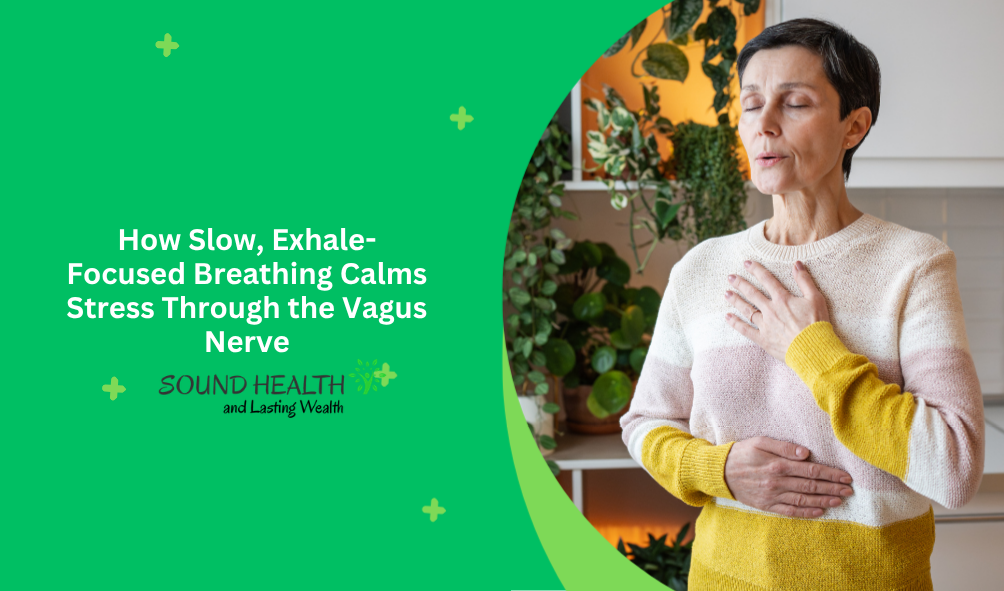
Slow, deliberate breathing, especially breathing that stretches out the exhale, is one of the simplest and best-supported ways to calm your body’s stress response. The reason it works comes down largely to the vagus nerve, the main communication line of your parasympathetic nervous system, which is the “rest and digest” side of your physiology. When you slow your breath, you increase activity along this pathway, and your heart rate, blood pressure, and sense of tension tend to follow.
That said, a lot of what you will read about “hacking” or “resetting” the vagus nerve overstates the case. The nerve is not a switch you flip, and breathing is not a cure for anxiety disorders. What the research does support is more modest and more useful: a handful of specific breathing patterns can measurably shift your nervous system toward calm, and they take only a few minutes to do. This article covers the ones with the strongest evidence, how to do each one, and where the popular claims get ahead of the science.

Also Read | Teen Anxiety Warning Signs in 2026 Every Parent Needs to Know
What “vagus nerve stimulation” through breathing actually means
The vagus nerve is the longest of the cranial nerves. It runs from the brainstem down through the neck and chest to the abdomen, and it carries signals in both directions between the brain and major organs, including the heart, lungs, and gut. It is the main pathway of the parasympathetic nervous system, the branch that slows the heart, lowers arousal, and promotes recovery, in contrast to the sympathetic “fight or flight” branch that speeds things up under stress.
Here is the key physiological link. Your heart rate naturally rises slightly when you breathe in and falls when you breathe out, an effect called respiratory sinus arrhythmia. That rise and fall is driven largely by the vagus nerve. When you breathe slowly and extend the exhale, you give the vagus more influence over each heartbeat, which nudges your whole system toward the calm, parasympathetic state.
Researchers measure this indirectly using heart rate variability, or HRV, which is the moment-to-moment variation in the time between heartbeats. Higher vagally-mediated HRV generally reflects stronger parasympathetic activity. So when studies say a breathing technique “stimulates the vagus nerve,” what they usually mean is that it increases this HRV marker, not that it directly zaps the nerve itself.
Why slow breathing calms you down
The mechanism is fairly well understood at a basic level. Slowing your breathing rate to roughly six breaths per minute or fewer appears to synchronize your breathing with natural rhythms in your cardiovascular system, amplifying the vagus nerve’s braking effect on the heart. A 2022 systematic review and meta-analysis published in Neuroscience and Biobehavioral Reviews, which pooled 223 studies, concluded that voluntary slow breathing increases vagally-mediated heart rate variability both during the practice and afterward.
Extending the exhale seems to matter specifically. The vagus nerve is more active during exhalation, so breathing patterns with a longer out-breath than in-breath tend to produce a stronger calming effect. A 2021 study in Scientific Reports found that a single session of deep, slow breathing with a longer exhale increased parasympathetic activity and reduced anxiety in both younger and older adults.
Slow breathing also engages the baroreflex, a blood pressure regulation system. A study of people with high blood pressure found that slow breathing shifted the balance of the autonomic nervous system toward vagal (calming) activity and increased baroreflex sensitivity, which the researchers described as a safe potential aid for managing essential hypertension. This does not make breathing a treatment for high blood pressure, but it helps explain why the effect feels physical, not just mental.
Also Read | How to Reduce Stress and Anxiety Fast: 8 Tips for Instant Calm
The best evidence-based breathing exercises
The techniques below are ordered roughly by how directly the recent evidence supports them for mood and stress. All of them are gentle and suitable for most healthy people. None involves forceful breathing or extended breath holding.
1. Cyclic sighing (the physiological sigh)
This is the standout technique from recent research. It emphasizes a long, complete exhale.
Research: A 2023 randomized controlled trial from Stanford University, published in the journal Cell Reports Medicine and led by researchers including David Spiegel and Andrew Huberman, compared three breathing techniques with mindfulness meditation in just over 100 healthy adults. Each person practiced their assigned technique for five minutes a day for a month. All groups improved, but the breathing groups reported greater gains in positive mood, and the exhale-focused cyclic sighing produced the biggest mood improvement and the largest reduction in breathing rate.
How to do it: Take a normal inhale through your nose, then, without exhaling, take a second short sip of air to top off your lungs. Then let out a long, slow, complete exhale through your mouth. Repeat for one to five minutes. Even one to three of these “double inhale, long exhale” cycles can take the edge off a sudden spike of stress.
Practical meaning: This is arguably the best “in the moment” technique for acute stress, and it doubles as a short daily practice.
Limitation: The Stanford trial was one month long in mostly healthy adults, and the mood benefits, while real, were measured on self-report scales. It was not a study of people with diagnosed anxiety or depression.
2. Coherent (resonance) breathing
This technique aims for a steady, even rhythm of about five to six breaths per minute, which is the rate that tends to maximize heart rate variability for most people.
How to do it: Breathe in gently through your nose for about five to six seconds, then out for about five to six seconds, with no strain and no breath holding. Continue for 5 to 10 minutes. A common starting point is a count of five in and five out, adjusting until it feels smooth.
Practical meaning: This is the technique most closely tied to the HRV research, and it works well as a longer daily practice to build a calmer baseline over time.
Limitation: The most reliable, measurable effects are on HRV during and shortly after practice. Longer-term mental health benefits are supported but come from smaller and more varied studies.
3. Extended exhale breathing
A simpler version of the same principle: make your exhale longer than your inhale. A widely used ratio is breathing in for a count of four and out for a count of six, or any comfortable pattern where the out-breath is clearly longer.
How to do it: Inhale gently through your nose for a count of four, then exhale slowly through your nose or mouth for a count of six. Repeat for a few minutes. The popular “4-7-8” pattern (inhale four, hold seven, exhale eight) is a variation on this idea, though the specific 4-7-8 counts have less direct research behind them than the general principle of a longer exhale.
Practical meaning: Easy to remember and do anywhere, which makes it a good default for everyday stress.
4. Diaphragmatic (belly) breathing
This is the foundation underneath the others: breathing deeply into the lower lungs using the diaphragm, rather than shallow breathing high in the chest.
How to do it: Place one hand on your chest and one on your belly. Breathe in slowly so that the hand on your belly rises while the hand on your chest stays relatively still. Exhale slowly. This ensures your slow-breathing practice is actually deep and efficient.
Practical meaning: Worth practicing on its own until it feels natural, because it makes every other technique more effective.
5. Box breathing
Popular in high-pressure professions, box breathing uses equal counts for each phase: inhale, hold, exhale, hold.
How to do it: Inhale for a count of four, hold for four, exhale for four, hold for four. Repeat.
Practical meaning: Useful and calming, and it was one of the techniques tested in the Stanford trial. Worth knowing that in that study, the exhale-focused cyclic sighing edged it out for mood improvement, likely because box breathing gives equal weight to the inhale rather than emphasizing the calming exhale.
What the broader research shows
Beyond individual techniques, the overall evidence for breathwork as a stress tool is encouraging but measured. A 2023 meta-analysis published in Scientific Reports pooled 12 randomized controlled trials involving 785 adults and found that breathwork was associated with a small-to-medium reduction in self-reported stress compared with control conditions. The authors also noted that most of the included studies carried a moderate risk of bias, which is a common and honest limitation in this field.
Expert interpretation: In plain terms, the research supports breathing exercises as a genuinely helpful, low-cost, low-risk stress management tool, with effects that are real but generally modest rather than dramatic.
Practical meaning for you: These techniques are well worth building into your routine, and they can help in a tense moment, but consistency over weeks matters more than expecting a single session to transform how you feel.
What to avoid
- Do not force your breath. Straining, gasping, or over-breathing works against the calming effect and can make you lightheaded.
- Be cautious with intense breathwork. Techniques involving rapid, forceful breathing or long breath holds (such as some hyperventilation-based methods) are a different category from the gentle slow breathing described here. They can cause dizziness, tingling, and even fainting.
- Never do breath holds or intense breathwork in or near water, while driving, or while standing somewhere you could fall. Fainting during breath holding has caused serious injuries and drownings.
- Do not treat breathing exercises as a replacement for professional treatment of an anxiety disorder, panic disorder, depression, or any other diagnosed condition.
- Do not expect a breathing technique to stop a full panic attack on its own, and know that for some people, focusing intensely on the breath can briefly increase anxiety. If that happens, a gentler or shorter practice, or a different grounding technique, may suit you better.
Also Read | Fatty Liver Symptoms in Women Over 50: 8 Silent Signs Doctors Miss
When to talk to a healthcare professional
Breathing exercises are a self-care tool, not a diagnosis or treatment. Consider speaking with a doctor or mental health professional if:
- Stress, anxiety, or low mood is frequent, persistent, or interfering with your daily life, work, sleep, or relationships.
- You experience panic attacks, or physical symptoms like chest pain, a racing heart, or shortness of breath that you have not had evaluated.
- You have a heart condition, a respiratory condition such as COPD or uncontrolled asthma, are pregnant, have a history of fainting, or have epilepsy, and you want to try more intense breathwork. Gentle slow breathing is generally safe, but it is wise to check first.
- You have thoughts of self-harm or hopelessness, in which case reaching out to a professional or a crisis line promptly is important.
A professional can help sort out whether what you are feeling is everyday stress that self-care can ease, or something that would benefit from proper evaluation and treatment.
What the evidence does NOT prove
This is where a lot of popular content overreaches, so it is worth being clear.
The phrase “stimulate your vagus nerve” makes breathing sound like a direct switch, but that is not quite what is happening. A useful piece of context comes from research on transcutaneous auricular vagus nerve stimulation, a method that uses a small electrical device to stimulate a branch of the vagus nerve at the ear. Reviews have found that this direct electrical stimulation, on its own, does not reliably increase heart rate variability in healthy people. When studies combined it with slow breathing and saw benefits, the slow breathing appeared to be doing most of the work. In other words, the calming effect people attribute to “vagus nerve stimulation” is really about the breathing pattern itself, not a special trick that unlocks the nerve.
It is also important to note what breathing exercises are not shown to do. They are not proven to cure or replace treatment for depression, anxiety disorders, high blood pressure, or any medical condition. HRV, the marker most of this research relies on, is a useful but imperfect measure of vagal activity, and some researchers caution against over-interpreting it. Many of the underlying studies are small, short, and carry a moderate risk of bias. The honest summary is that these are helpful, well-tolerated tools that shift your physiology toward calm, not medical treatments.
The bottom line
If you want a practical takeaway, start with the exhale. Breathing slowly, deeply, and with a longer out-breath than in-breath is the common thread across nearly all the evidence, and cyclic sighing is the technique with the strongest recent support for lifting mood in just five minutes a day. Coherent breathing at about six breaths per minute is an excellent longer daily practice, and diaphragmatic breathing is the foundation that makes everything else work better.
These techniques genuinely engage the vagus nerve and the calming side of your nervous system, and they are free, portable, and safe for most people. What they are not is a cure or a substitute for professional care. Used realistically, as a daily habit and an in-the-moment reset rather than a miracle fix, they are one of the most accessible stress management tools available.
Also Read | Yoga for High Blood Pressure: Lower Your Numbers by 4+ Points Fast
References
- Yilmaz Balban M, Neri E, Kogon MM, et al. “Brief structured respiration practices enhance mood and reduce physiological arousal.” Cell Reports Medicine, 4(1): 100895, published January 10, 2023. https://doi.org/10.1016/j.xcrm.2022.100895
- Laborde S, Allen MS, Borges U, et al. “Effects of voluntary slow breathing on heart rate and heart rate variability: A systematic review and meta-analysis.” Neuroscience and Biobehavioral Reviews, 2022. https://doi.org/10.1016/j.neubiorev.2022.104711
- Fincham GW, Strauss C, Montero-Marin J, Cavanagh K. “Effect of breathwork on stress and mental health: A meta-analysis of randomised-controlled trials.” Scientific Reports, 13(1): 432, 2023. https://doi.org/10.1038/s41598-022-27247-y
- Magnon V, Dutheil F, Vallet GT. “Benefits from one session of deep and slow breathing on vagal tone and anxiety in young and older adults.” Scientific Reports, 11(1): 19267, 2021. https://doi.org/10.1038/s41598-021-98736-9
- Mason H, Vandoni M, et al. / Chaitanya S, et al. Research on slow breathing, baroreflex sensitivity, and heart rate variability in essential hypertension. (See NCBI PMC6392805.) https://www.ncbi.nlm.nih.gov/pmc/articles/PMC6392805/
- Ashton J, et al. “Expiratory-gated transcutaneous auricular vagus nerve stimulation (taVNS) does not further augment heart rate variability during slow breathing at 0.1 Hz.” (See NCBI PMC10412484.) https://www.ncbi.nlm.nih.gov/pmc/articles/PMC10412484/
- Cregg R, et al. / Yackle K, Feldman JL, Krasnow MA, et al. Discovery of brainstem neurons linking breathing and arousal (basis of the physiological sigh). Science, 2017.