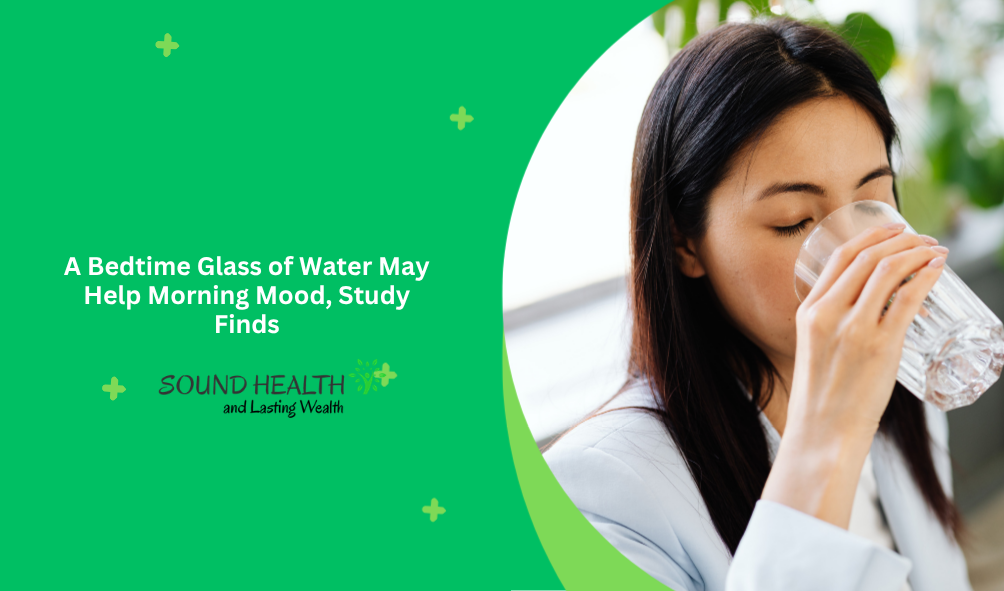

Yes, drinking enough water is linked to better mood, and the research on this has grown stronger in the past few years. Even mild dehydration, the kind that happens on an ordinary day without any exercise or heat exposure, has been shown to affect how people feel. And in early 2026, a study added a specific new detail to this picture: a small glass of plain water right before bed appeared to ease depressive mood the next morning in a group of middle-aged men, though it came with one clear trade-off.
This is not a claim that water cures depression or anxiety. It is a much narrower, well-supported idea: your fluid balance is one of several everyday factors that can nudge your mood up or down, and the timing of when you drink water, not just how much, may matter more than most people assume.

Key Takeaways
- Mild dehydration, as little as 1 to 2 percent of body weight in fluid loss, has been repeatedly linked to worse mood, fatigue, and difficulty concentrating in healthy adults, even without exercise or heat.
- A 2026 study in the journal PLOS ONE found that men who drank 280 mL (about one cup) of plain water immediately before bed reported lower depressive mood the next morning than when they skipped it, along with measurable changes in REM sleep.
- The same study also found this habit increased nighttime bathroom trips, so it is a genuine trade-off rather than a free win.
- Daytime hydration habits, not just a bedtime ritual, have the stronger and more consistent evidence base for supporting mood.
- Water is a helpful, low-risk habit to support mood, but it is not a treatment for clinical depression or anxiety, and it should not replace professional care when symptoms are persistent or severe.
How hydration and mood are connected
Water makes up roughly 50 to 70 percent of an adult’s body weight, and nearly every system involved in thinking and feeling, including blood volume, brain cell function, and hormone regulation, depends on adequate fluid. When fluid intake drops even slightly below what the body needs, researchers call this mild dehydration, and it is far more common than people realize. It does not require sweating through a workout or being stuck outside on a hot day. Simply forgetting to drink water during a busy morning can be enough.
Mood researchers distinguish this from severe dehydration, which is a medical emergency involving confusion, dangerously low blood pressure, and organ strain. Mild dehydration is subtler. It tends to show up as fatigue, irritability, a harder time concentrating, and a flatter or more negative mood, without any of the obvious warning signs like extreme thirst or dizziness.
Why even small fluid changes affect how you feel
Researchers do not have a single, fully confirmed explanation for why mild dehydration affects mood, but several plausible mechanisms have been studied. Reduced blood volume from fluid loss can lower blood pressure slightly and reduce blood flow efficiency, including to the brain. Dehydration also raises the stress hormone cortisol in some studies, and it can concentrate the blood, which may affect how efficiently the brain clears waste products and regulates neurotransmitters.
There is also a sleep-related angle. The body loses an estimated 400 to 700 mL of water overnight through breathing and skin evaporation alone, since drinking during sleep is not possible. If a person goes to bed already low on fluids, that overnight loss can leave them more dehydrated by morning than they were the night before, which may partly explain why some people wake up groggy, foggy, or low in mood without an obvious cause.
What the research on daytime hydration shows
The clearest and most consistent evidence comes from studies on daytime hydration in healthy adults. A frequently cited 2012 study published in the Journal of Nutrition found that mild dehydration, equal to about 1.4 percent of body weight in fluid loss, was linked to increased fatigue, more difficulty concentrating, and reduced vigor in a group of young women, even though the dehydration level was mild enough that most participants did not feel notably thirsty. A related study in men found similar mood effects, alongside a bigger hit to short-term memory and reaction time under heat and exercise conditions.
A broader review of this research area, published in Nutrition Reviews, concluded that when dehydration reaches roughly 2 percent of body weight, mood effects are consistently observed, fatigue increases, and alertness drops, while effects on measurable cognitive performance are less consistent from study to study. Separately, a large cross-sectional study published in the World Journal of Psychiatry found that adults who reported drinking more plain water had a lower likelihood of reporting depression and anxiety symptoms, though this type of study can show an association without proving that water intake alone causes the difference.
Taken together, this body of research supports a fairly conservative conclusion: staying adequately hydrated during the day is associated with steadier mood and energy, and letting hydration slip, even modestly, is associated with feeling worse.
What the new bedtime study adds
The daytime research above has existed in some form for over a decade. What is new is a study published in January 2026 in the peer-reviewed journal PLOS ONE, led by researchers from Japan’s National Institute of Advanced Industrial Science and Technology, which looked specifically at nighttime hydration rather than daytime intake.
Research: The study had two parts. First, researchers surveyed nearly 1,000 Japanese adults and found that people who reported drinking more water before bed also reported lower depressive mood scores the next morning, and people who woke up thirsty tended to report worse mood and worse sleep quality. Second, and more rigorously, the researchers ran a controlled experiment with 55 healthy men in their 50s. Each man spent nights in a sleep lab under two conditions on different occasions: one where he drank 280 mL of plain water (about one cup) immediately before lights out, and one where he had no beverages for at least two hours before bed. Sleep was measured using real polysomnography equipment, the same type of monitoring used in clinical sleep studies.
What they found: On the mornings after drinking water before bed, participants reported somewhat lower depressive mood scores than after the no-water condition. The water condition was also linked to a longer delay before REM sleep began and a shorter total amount of REM sleep, a sleep stage that has been linked to mood regulation in other research. However, drinking water before bed also increased how often participants needed to use the bathroom overnight, and mild next-morning thirst was still slightly higher in the group that had not had water, which the researchers took as a sign the pre-bed water had helped prevent overnight dehydration.
Practical meaning: For a healthy adult without a bladder or kidney condition, a modest glass of plain water shortly before bed appears to be a low-cost, low-risk habit that may modestly support next-morning mood, largely by reducing how dehydrated the body becomes overnight.
Limitation: This was a small study of only 55 healthy men aged 50 to 59 in Japan, tested over a short period in a sleep lab rather than at home over the long term. The mood improvement the researchers measured was real but modest in size, and the study’s own authors described the effect size as relatively small. It has not yet been repeated in women, younger adults, or people with diagnosed depression, and the researchers themselves called for further studies before drawing broad conclusions. This single study is also not strong enough evidence, on its own, to call pre-bed water a proven treatment for low mood.
Signs your mood dip might be hydration-related
Not every bad mood is about water, and it is easy to over-attribute normal emotional ups and downs to hydration. That said, a few patterns are worth noticing:
- Feeling unusually tired, foggy, or irritable on a day when you know you have had little to drink
- Waking up with a dry mouth, dark yellow urine, or a mild headache alongside low mood or grogginess
- Noticing your mood and focus improve within an hour or two of drinking water after a period of low intake
- Mood dips that track closely with hot weather, illness, or busy days when you forget to drink
None of these signs confirm dehydration is the cause, and none of them rule out other explanations. They are simply patterns worth paying attention to before assuming something more serious is happening.
What can actually help
Evidence-supported daytime habit: Aim for steady water intake throughout the day rather than large amounts all at once. In the United States, the National Academies of Sciences, Engineering, and Medicine (formerly the Institute of Medicine) suggests an average total water intake, including water from food, of about 3.7 liters (roughly 125 ounces) per day for adult men and about 2.7 liters (roughly 91 ounces) per day for adult women. Guidelines vary somewhat by country and health authority, and individual needs depend on body size, activity level, climate, and health conditions, so these figures are a general reference point rather than a strict target for everyone.
Lifestyle measure that may help: Based on the 2026 PLOS ONE study, a modest glass of plain water (roughly 200 to 300 mL, or about one cup) shortly before bed may support next-morning mood for some healthy adults, mainly by reducing overnight dehydration. This is a reasonable, low-risk habit to try rather than a guaranteed fix.
Practical tips:
- Keep a water bottle somewhere visible during the day as a simple reminder.
- Pay attention to urine color as a rough hydration check. Pale yellow generally suggests adequate hydration, while consistently dark yellow suggests you may need more fluids.
- Foods with high water content, such as fruits and vegetables, count toward total daily fluid intake.
- If you try the bedtime water habit, keep the amount modest. Large volumes right before bed are more likely to disrupt sleep through extra bathroom trips.
What to avoid
- Do not use dramatic swings in water intake, like drinking very large amounts in a short period, as a way to try to fix mood quickly. This does not have supporting evidence and, in rare cases, drinking excessive water in a short time can cause a dangerous drop in blood sodium levels.
- Do not treat plain water as a substitute for treatment of diagnosed depression, anxiety, or other mental health conditions.
- Do not assume the bedtime water habit is right for everyone. People with nighttime urinary frequency, an enlarged prostate, certain kidney conditions, or heart failure should talk with a healthcare provider before deliberately increasing fluid intake before bed, since it may worsen nighttime symptoms or interact with fluid-restriction advice they have already been given.
- Do not rely on thirst alone as a hydration signal, since thirst often lags behind the body’s actual need for water, particularly in older adults.
When to talk to a healthcare professional
Occasional low mood connected to a hot day or a forgotten water bottle is common and usually resolves once you rehydrate. Consider speaking with a doctor or mental health professional if:
- Low mood, sadness, or lack of interest in activities lasts most of the day for two weeks or longer
- Mood changes are accompanied by changes in sleep, appetite, energy, or concentration that are affecting daily life
- You have thoughts of self-harm or hopelessness
- You have a kidney, heart, or bladder condition and are considering changing your fluid intake, especially before bed
- Dehydration symptoms are severe, including confusion, a rapid heartbeat, or the inability to keep fluids down
A healthcare provider can help determine whether hydration, sleep, an underlying medical condition, or a mental health condition is contributing to how you feel, and can recommend fluid intake targets that are appropriate for your specific health situation.
What the evidence does NOT prove
It is worth being direct about the limits of this research. The daytime hydration studies mostly show correlation, meaning people who drink more water also tend to report better mood, without fully proving that water intake is the cause rather than, for example, healthier habits generally clustering together. The 2026 bedtime study was a controlled experiment, which is stronger evidence of cause and effect, but it involved a small, specific group: 55 healthy middle-aged Japanese men without diagnosed depression, tested over a short period. It does not establish that the same habit works the same way for women, younger or older adults, people with clinically diagnosed depression, or people outside the study’s home country and climate. The study was also funded by a beverage company, which the study authors disclosed and which is worth knowing about even though the authors reported no competing interests. None of this means the finding is wrong, but it does mean “drink water before bed to cure your mood” overstates what a single, modest-sized study can support.
The bottom line
The connection between hydration and mood is one of the better-supported everyday wellness claims, at least for the general idea that mild dehydration can worsen how you feel and adequate water intake supports steadier mood and energy. The newer finding, that a modest glass of water before bed may specifically help next-morning mood by limiting overnight dehydration, is a genuinely interesting and recent addition to that picture, but it comes from a small study with a real trade-off in the form of more nighttime bathroom trips.
For most healthy adults, drinking water consistently throughout the day, and considering a modest glass before bed if nighttime bathroom trips are not a concern, is a low-risk habit that may support mood alongside other basics like sleep, movement, and nutrition. It is not, on the current evidence, a replacement for professional support when mood problems are persistent or severe.
Also Read | Feeling Irritable After 50? 7 Foods That Boost Your Mood Fast
References
- Kaida K, Itoi K, Soeta Y, Ooie T, Oishi K. “Effects of plain water intake before bedtime on sleep and depressive mood among middle-aged Japanese men.” PLOS ONE, 21(1): e0340490, published January 6, 2026. https://doi.org/10.1371/journal.pone.0340490
- Armstrong LE, Ganio MS, Casa DJ, et al. “Mild dehydration affects mood in healthy young women.” Journal of Nutrition, 142(2), 382-388, 2012. https://doi.org/10.3945/jn.111.142000
- Ganio MS, Armstrong LE, Casa DJ, et al. “Mild dehydration impairs cognitive performance and mood of men.” British Journal of Nutrition, 106(10), 1535-1543, 2011.
- Benton D, Young HA. “Do small differences in hydration status affect mood and mental performance?” Nutrition Reviews, 73(Suppl 2), 83-96, 2015.
- Masento NA, Golightly M, Field DT, Butler LT, van Reekum CM. “Effects of hydration status on cognitive performance and mood.” British Journal of Nutrition, 111(10), 1841-1852, 2014.
- Haghighatdoost F, Feizi A, Esmaillzadeh A, et al. “Drinking plain water is associated with decreased risk of depression and anxiety in adults.” World Journal of Psychiatry, 8(3), 88-96, 2018.
- National Academies of Sciences, Engineering, and Medicine (Institute of Medicine). Dietary Reference Intakes for Water, Potassium, Sodium, Chloride, and Sulfate – total water intake guidance (United States).