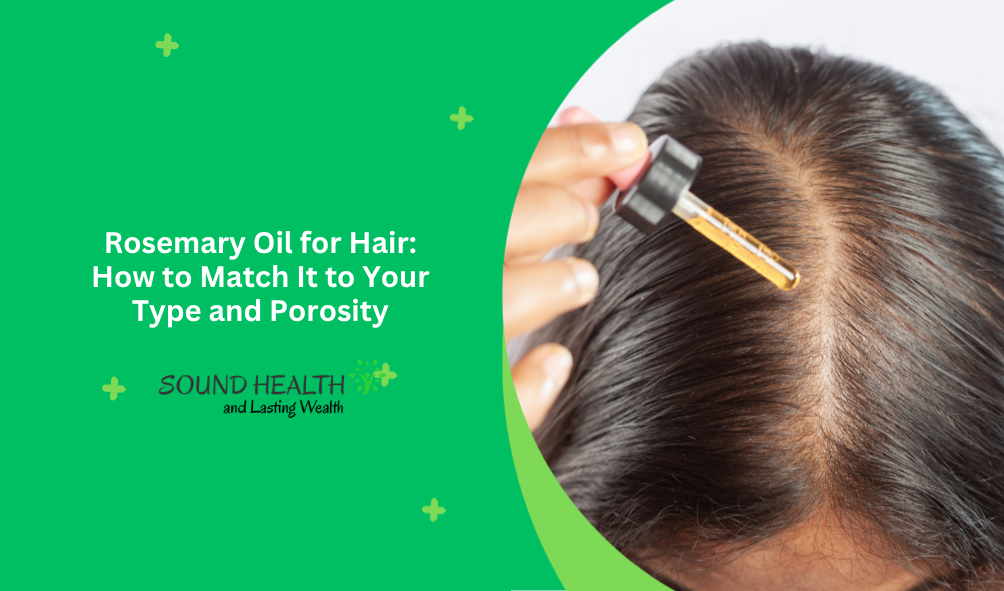

Rosemary oil has become one of the most talked-about natural hair ingredients, and a common question is whether it suits your particular hair type and porosity. Here is the reassuring and clarifying answer: because rosemary oil works mainly as a scalp treatment, it can suit all hair types and porosities, essentially. Your hair’s porosity does not really decide whether rosemary oil works; it decides how you should use it so you get the benefit without weighing your hair down or causing buildup.
That distinction is the key to using it well, and it is one most guides gloss over. It is also worth being honest about the evidence, since the viral claim that rosemary oil rivals prescription treatments comes from a single study with real limitations. This guide covers what rosemary oil can and cannot do, then gives practical, tailored advice on how to use it for your specific hair type and porosity.

Key Takeaways
- Rosemary oil is primarily a scalp treatment, so it can work for most hair types and porosities. Porosity affects how you apply it, not whether it works.
- The evidence for hair growth is promising but limited, resting largely on one 2015 study that has been questioned on methodological grounds and compared rosemary to the weaker 2 percent minoxidil.
- Low porosity, fine, or oily hair does best with light carrier oils used sparingly to avoid buildup.
- High porosity, dry, or coarse hair can handle richer carrier oils, which help seal in moisture.
- Rosemary essential oil must always be diluted in a carrier oil and patch tested, never applied undiluted.
- For significant or sudden hair loss, see a dermatologist, since rosemary oil is not a substitute for a proper diagnosis or proven treatment.
What rosemary oil actually does for hair
Rosemary oil’s potential benefits happen at the scalp and follicle level. Researchers believe it may support hair through a few mechanisms: improving blood circulation to the scalp, calming inflammation with its antioxidant compounds, and possibly mildly inhibiting an enzyme called 5-alpha-reductase, which converts testosterone into DHT, the hormone linked to pattern hair loss. These mechanisms are plausible, but most of the supporting evidence comes from laboratory and animal studies, which do not always translate to real results on a human scalp.
The most cited human evidence is a 2015 randomized trial that compared rosemary oil with 2 percent minoxidil in 100 people with androgenetic alopecia, or pattern hair loss, over six months. Both groups saw a similar increase in hair count, and the rosemary group reported less scalp itching. That sounds impressive, but it deserves context, which the next-to-last section covers in full. In short, it is a single study with acknowledged limitations, so rosemary oil is best seen as a promising scalp-health habit rather than a proven treatment.
Does hair porosity change whether rosemary oil works?
This is where a lot of confusion creeps in, so it is worth being clear. Porosity describes how well your hair strands absorb and hold moisture, based on how tight or raised the outer cuticle is. Low porosity hair has a tight cuticle that resists moisture, so products tend to sit on top. High porosity hair has a raised or damaged cuticle that absorbs quickly but loses moisture fast.
Here is the key point: rosemary oil’s potential benefits act on your scalp and follicles, not on the porosity of your hair strands. So porosity does not determine whether rosemary oil “works” for scalp health or hair growth. What porosity does affect is how the oil behaves on your hair, specifically whether it absorbs cleanly or builds up and weighs your hair down. That means the real question is not whether rosemary oil suits your porosity, but how to apply it so it suits your porosity. The rest of this guide answers exactly that.
How to use rosemary oil for your hair type and porosity
The oil itself stays the same. What changes is your choice of carrier oil, how much you use, and how often. Match the approach to your hair below.
Low porosity, fine, or oily hair
If your hair is low porosity, fine, or your scalp gets oily, buildup is your main concern, since heavy oils sit on the surface rather than absorbing. To get the scalp benefit without a greasy, weighed-down result:
- Choose light carrier oils that absorb easily, such as jojoba, which mimics your scalp’s natural oils, or grapeseed, which is very lightweight. If you like coconut oil, use fractionated coconut oil, which is lighter than the regular kind.
- Use it sparingly and focus on the scalp rather than coating the lengths.
- Apply before washing, leave it on for around 30 minutes, and shampoo it out thoroughly.
- Warming the diluted oil slightly, or applying it in a steamy bathroom, helps it spread and absorb.
- Start with once a week, since frequent use can quickly overwhelm low porosity hair.
- If buildup is a persistent problem, a lighter rosemary water or hydrosol rinse can be a good alternative to oil.
High porosity, dry, or coarse hair
If your hair is high porosity, dry, coarse, or color-treated, it absorbs oil readily and struggles to retain moisture, so richer oils are an asset here. Oils help seal the cuticle and lock in hydration:
- You can use more nourishing carrier oils such as argan, avocado, or regular coconut oil, which coat and condition the strands as well as deliver rosemary to the scalp.
- Apply the diluted blend to your scalp and comb a little through the mid-lengths and ends to help seal in moisture.
- You can leave it on longer, and some people with very dry, coarse hair tolerate an occasional overnight treatment with a light film.
- Two to three times a week can work well if your scalp tolerates it.
Medium or normal porosity hair
If your hair is medium or normal porosity, you have the most flexibility. Most carrier oils will work, so you can choose based on preference and how your hair feels. A balanced, medium-weight carrier like sweet almond or argan is a good default, applied a couple of times a week, adjusting the amount and frequency based on how your scalp and hair respond.
How to apply it safely, whatever your hair type
A few safety steps apply to everyone:
- Always dilute. Rosemary essential oil is far too concentrated for the scalp on its own. A good range is a 1 to 3 percent dilution, which is roughly 2 to 5 drops of rosemary oil per tablespoon of carrier oil.
- Patch test first. Apply a small amount of the diluted blend behind your ear or on your inner arm and wait 24 to 48 hours to check for redness, itching, or irritation before using it more widely.
- Focus on the scalp and massage gently with your fingertips for a couple of minutes, which feels pleasant and may itself support circulation.
- Start low and slow. Begin with a lower frequency and a lighter dilution, then build up only if your scalp is comfortable.
- Be patient. Any benefit takes months of consistent use to appear, not days.
What to avoid
- Do not apply rosemary essential oil undiluted. Neat essential oil can cause scalp irritation or contact dermatitis, and significant inflammation can, in some cases, even contribute to temporary shedding.
- Do not believe the hype that rosemary oil is proven to match prescription treatments. As explained below, that claim overstates a single limited study.
- Do not overuse it. Daily application is usually unnecessary and can irritate the scalp or cause buildup, especially in low porosity or fine hair.
- Do not use heavy oils on low porosity hair. They tend to sit on top and leave a greasy residue.
- Do not use it on broken or inflamed skin, or on an active scalp condition like dermatitis or psoriasis, without checking with a dermatologist first.
- Do not rely on rosemary oil to fix significant hair loss on its own, and do not delay getting a proper diagnosis if your hair loss is notable.
When to talk to a healthcare professional
Rosemary oil is a reasonable self-care habit, not a medical treatment. Consider seeing a doctor or dermatologist if:
- You are experiencing significant, sudden, or patchy hair loss, which needs proper evaluation.
- You have a scalp condition, persistent itching, flaking, or irritation.
- You have tried rosemary oil consistently for several months with no improvement.
- You are pregnant or breastfeeding, have a seizure disorder, or another medical condition, since rosemary essential oil is flagged for caution in these situations, so check before using it.
Hair loss has many possible causes, including genetics, thyroid problems, iron deficiency, stress-related shedding, and autoimmune conditions. A dermatologist can identify the cause and recommend evidence-based options, which may include proven treatments that rosemary oil cannot replace.
What the evidence does and does not show
To use rosemary oil wisely, it helps to know exactly where the science stands. The often-repeated claim that it works “as well as minoxidil” comes from that single 2015 trial, and the details matter. It compared rosemary oil with minoxidil at 2 percent, not the stronger and more effective 5 percent formulation, which produces considerably more regrowth, so rosemary oil has never been tested against the standard-strength treatment. The study also involved only 100 people and has since been questioned by independent reviewers over issues like duplicate figures and calculation anomalies. It is best treated as promising but not definitive.
The proposed mechanisms are real in the laboratory, but effects seen in cell cultures and mice do not automatically translate to a human scalp at the concentrations found in typical products, and no major dermatology guideline recommends rosemary oil as a replacement for established treatments. It is also worth knowing that many commercial “rosemary hair” products are either too dilute or are mostly fragrance, and results, if they come, take months of consistent use. None of this means rosemary oil is useless. It is a low-risk, pleasant scalp-care habit with some encouraging early evidence. It simply is not the proven miracle that viral posts suggest, and it is not a substitute for medical care when hair loss is significant.
The bottom line
Rosemary oil can suit almost any hair type and porosity, because it works mainly on your scalp rather than your hair strands. That means porosity should guide how you use it, not whether you use it: reach for light carrier oils and a sparing, once-weekly approach if your hair is low porosity, fine, or oily, and richer carriers used more freely if it is high porosity, dry, or coarse. Always dilute the essential oil, patch test, and give it months to work.
Keep your expectations realistic. The evidence for rosemary oil is promising but rests on one limited study, so treat it as a worthwhile scalp-care habit rather than a proven hair-loss cure. If you are dealing with significant or sudden hair loss, see a dermatologist for a proper diagnosis, and think of rosemary oil as a gentle complement to good hair care rather than a replacement for it.
Also Read | 5 Dermatologist-Recommended Ways to Manage Chin Hair for Women Over 50
References
- Panahi Y, Taghizadeh M, Marzony ET, Sahebkar A. “Rosemary oil vs minoxidil 2% for the treatment of androgenetic alopecia: a randomized comparative trial.” SKINmed, 13(1), 15-21, 2015. https://pubmed.ncbi.nlm.nih.gov/25842469/
- Independent analyses noting the study’s methodological concerns and the fact that it compared rosemary oil with 2% (not 5%) minoxidil, and that rosemary oil is not included in dermatology treatment guidelines.
- Murata K, et al. “Promotion of hair growth by Rosmarinus officinalis leaf extract.” Phytotherapy Research, 27(2), 212-217, 2013 (animal study).
- National Center for Complementary and Integrative Health and dermatology references on the plausible but preclinical mechanisms of rosemary (5-alpha-reductase inhibition, anti-inflammatory and antioxidant activity, scalp circulation).
- Dermatology and cosmetic-chemistry guidance on hair porosity and carrier oil selection (light oils such as jojoba and grapeseed for low porosity or fine hair; richer oils such as argan for high porosity or dry hair).
- Safe-use guidance on diluting rosemary essential oil (1 to 3 percent), patch testing, and cautions in pregnancy, breastfeeding, seizure disorders, broken skin, and active scalp conditions.