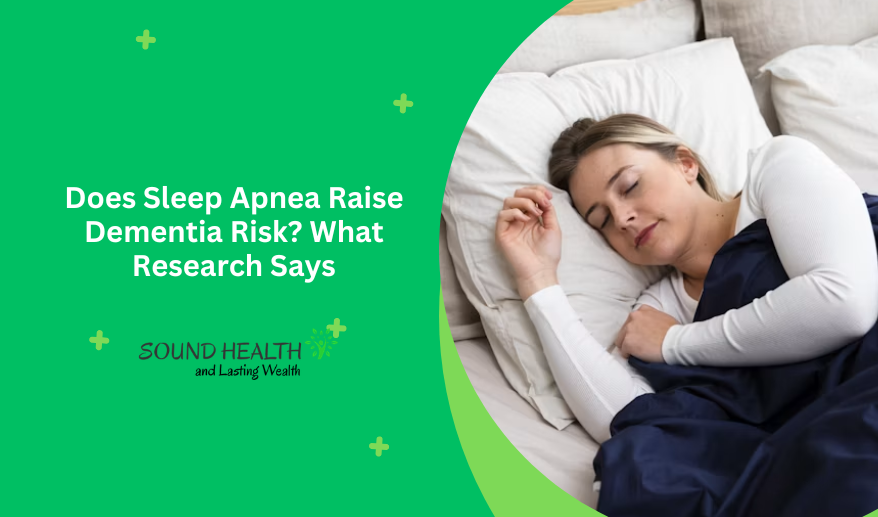

Obstructive sleep apnea (OSA), a common condition where breathing repeatedly stops and starts during sleep, has been linked in research to a higher risk of dementia. The connection is real enough that scientists are studying it closely, and it is a good reason to take undiagnosed or untreated apnea seriously.
But the honest picture is more measured than alarming headlines suggest. A large 2024 study of more than 18,500 US adults found that people over 50 with known or suspected sleep apnea had a higher chance of a later dementia diagnosis, an association that was stronger in women (Michigan Medicine, 2024). However, the absolute difference in dementia diagnoses stayed under 5%, and this was an observational study, meaning it shows a link, not proof that apnea causes dementia.
Notably, when the influential 2024 Lancet Commission listed the modifiable risk factors behind dementia, it did not include sleep apnea as a confirmed one, saying only that it “might be associated” (Michigan Medicine, 2024). So the accurate takeaway is: a genuine, worth-taking-seriously link, not an established cause, and treating apnea makes sense regardless because of its many other proven benefits.
What you will learn:
- What the research actually found, and its limits
- Why the link may be stronger in women
- How sleep apnea could affect the brain
- Whether treating it (with CPAP) helps
- Why treating apnea is worthwhile either way

What Is Obstructive Sleep Apnea?
Obstructive sleep apnea is a condition in which the airway repeatedly narrows or collapses during sleep, causing breathing to pause, sometimes hundreds of times a night. Each pause briefly drops oxygen levels and jolts the brain toward wakefulness, fragmenting sleep even if the person does not fully wake.
Common signs include loud snoring, gasping or choking during sleep, witnessed breathing pauses, morning headaches, and daytime sleepiness. Crucially, many people do not know they have it, which is part of why researchers study “known or suspected” apnea together.
It is very common and often underdiagnosed, particularly in women, whose symptoms tend to look different from the classic loud-snoring picture. Untreated, OSA is linked to high blood pressure, heart disease, stroke, and type 2 diabetes, so its health effects reach well beyond tiredness.
Also Read | Most Relaxing Music for Stress: Reset Your Nervous System Fast
What the Research Actually Found
Let us look at the evidence squarely, both what it shows and what it cannot.
The Large 2024 Study
Researchers at the University of Michigan examined survey and cognitive data from more than 18,500 adults to assess how known or suspected OSA related to dementia risk (Michigan Medicine, 2024).
Key findings:
- Adults aged 50 and older with known or suspected sleep apnea had a higher chance of later showing signs of, or being diagnosed with, dementia.
- The association remained statistically significant even after accounting for factors like race and education.
- At every age level, women with known or suspected apnea were more likely than men to be diagnosed with dementia.
The Crucial Context
Three points keep this in proportion:
- The absolute difference was small. The overall gap in dementia diagnoses never rose above 5% (Michigan Medicine, 2024).
- It was observational. The study shows an association, not that apnea causes dementia. Other factors could drive part of the link.
- Expert bodies remain cautious. The 2024 Lancet Commission on dementia, which identified modifiable risk factors accounting for around 40% of global dementia, did not add sleep apnea to its confirmed list, noting only that it “might be associated” and suggesting further attention (Michigan Medicine, 2024).
The Broader Evidence
Other large studies point the same general direction. A UK analysis of primary-care data concluded that OSA is associated with higher risks of all-cause dementia and some subtypes, while explicitly noting that its precise relationship with dementia remains uncertain and calling for more research (Wang et al., 2025). Some cohort studies find lower cognitive performance in people with OSA; others do not, reflecting genuine scientific uncertainty (CLSA analysis, 2023).
The consistent thread is a real but not fully understood association, worth acting on cautiously, not a settled cause-and-effect.
Why the Link May Be Stronger in Women
One of the most striking findings is that the apnea-dementia association appeared stronger in women. Researchers do not fully know why, but several factors are plausible and under active study.
- Underdiagnosis. Sleep apnea is frequently missed in women because their symptoms, fatigue, insomnia, morning headaches, and mood changes, differ from the classic loud-snoring presentation. Longer time undiagnosed and untreated could mean more cumulative effect.
- Menopause. Apnea risk in women rises substantially after menopause, as falling estrogen and progesterone affect the airway and sleep. This overlaps with a period of increased dementia risk.
- Sex-specific brain effects. Some researchers are investigating whether post-menopausal changes in sleep architecture and brain inflammation make women’s brains more vulnerable to apnea’s effects (Sheikh Ibrahim, 2025).
This does not mean women should be alarmed, but it does strengthen the case for taking women’s sleep symptoms seriously rather than attributing everything to stress or menopause.
How Might Sleep Apnea Affect the Brain?
Researchers have proposed several biologically plausible ways untreated apnea could harm the brain over time. These are mechanisms under study, not proven pathways, but they help explain why the association is taken seriously.
| Proposed mechanism | What it means |
|---|---|
| Intermittent low oxygen | Repeated drops in oxygen (hypoxia) may stress brain tissue over years |
| Sleep fragmentation | Constant micro-arousals disrupt the deep sleep needed for brain maintenance and memory |
| Impaired brain “clearance” | Deep sleep helps clear metabolic waste from the brain; fragmented sleep may reduce this |
| Inflammation | Apnea is associated with inflammatory changes in the brain that may contribute to cognitive decline |
| Cardiovascular strain | Apnea worsens high blood pressure and heart disease, themselves dementia risk factors |
That last point matters. Some of apnea’s possible effect on the brain may run through the heart and blood vessels, since untreated OSA drives up blood pressure and cardiovascular disease, both established contributors to dementia risk (Michigan Medicine, 2024).
Also Read | Best Exercise for Sleep After 50: What Research Shows
Does Treating Sleep Apnea Reduce Dementia Risk?
This is the question everyone wants answered, and it is where honesty matters most.
The main treatment for moderate to severe OSA is CPAP (continuous positive airway pressure), a machine that keeps the airway open with gentle air pressure during sleep. It is highly effective at treating the apnea itself when used consistently.
What the evidence shows on CPAP and cognition:
- Some studies suggest CPAP may produce modest improvements in cognitive performance, particularly attention and processing speed, especially in people with mild cognitive impairment (Springer, 2025).
- But benefits are variable and depend heavily on adherence (how consistently the machine is used), and the studies are limited (Springer, 2025).
- There is no definitive proof yet that CPAP prevents dementia. Researchers, including teams funded by the National Institute on Aging, are actively studying this, partly because dementia develops over decades, making it hard to measure (NIA-funded research, 2025).
So the honest answer is: treating apnea may help the brain, the early signs are encouraging, but it is not yet proven to prevent dementia. That uncertainty, however, does not weaken the case for treatment, for the reason below.
Why Treating Sleep Apnea Is Worthwhile Regardless
Here is the practical bottom line that cuts through the uncertainty. Even setting the dementia question aside entirely, treating sleep apnea has clear, well-established benefits:
- Lower blood pressure and reduced cardiovascular strain
- Reduced risk of heart disease and stroke
- Better blood sugar control
- Far less daytime sleepiness, and safer driving
- Improved mood, concentration, and quality of life
- Better, more restorative sleep
In other words, you do not need to wait for the dementia science to be settled to benefit from treating apnea. The other reasons are already compelling. If treatment also turns out to protect the brain, that is a bonus on top of benefits that are already proven.
This reframes the whole issue usefully. The question is not really “should I treat apnea to prevent dementia?” It is “should I treat a condition that harms my heart, my daytime function, and my sleep, and might also affect my brain?” The answer to that is clearly yes.
Recognising Sleep Apnea, Especially in Women
Because so many cases go undiagnosed, knowing the signs matters. Classic symptoms include:
- Loud, habitual snoring
- Gasping, choking, or witnessed pauses in breathing during sleep
- Excessive daytime sleepiness
Symptoms more common in women, which are easily missed or misattributed:
- Persistent fatigue rather than obvious sleepiness
- Insomnia and difficulty staying asleep
- Morning headaches
- Low mood, anxiety, or irritability
- Trouble with memory and concentration
- Night sweats
- Waking frequently to use the bathroom
If several of these apply, particularly around or after menopause, it is worth asking your doctor about a sleep assessment rather than assuming it is stress, ageing, or hormones.
Myths vs. Facts
| Myth | Fact |
|---|---|
| Sleep apnea definitely causes dementia | Research shows an association, not proven causation. |
| The dementia risk from apnea is huge | The absolute difference in one large study stayed under 5%. |
| Sleep apnea is a confirmed dementia risk factor | The 2024 Lancet Commission did not include it as confirmed. |
| CPAP is proven to prevent dementia | It may help cognition modestly, but prevention is not proven. |
| Sleep apnea is mainly a men’s condition | It is underdiagnosed in women, and the dementia link looked stronger in women. |
| If I don’t snore loudly, I don’t have apnea | Women especially may have apnea without classic loud snoring. |
| There’s no point treating apnea until the science is settled | Treatment has clear proven benefits for heart, mood, and daytime function. |
Common Mistakes to Avoid
- Panicking over the dementia link. The association is real but modest and not proven causal.
- Ignoring apnea because the dementia science is unsettled. Treatment helps your heart and daily life now.
- Assuming apnea is unlikely because you’re a woman. It is underdiagnosed in women.
- Attributing fatigue and brain fog only to menopause. Apnea can cause the same symptoms.
- Buying a CPAP without a diagnosis. Apnea should be properly diagnosed with a sleep study first.
- Getting a CPAP and not using it consistently. Benefits depend heavily on regular use.
Also Read | The Hidden Dangers of Checking Your Phone First Thing in the Morning
When to See a Doctor
Ask your doctor about a sleep assessment if you:
- Snore loudly or have been told you gasp or stop breathing in your sleep
- Wake unrefreshed despite enough time in bed
- Have persistent fatigue, morning headaches, or daytime sleepiness
- Have trouble with memory or concentration alongside poor sleep
- Have high blood pressure, heart disease, or diabetes plus poor sleep
- Are post-menopausal with new fatigue, insomnia, or mood changes
Seek prompt care if daytime sleepiness has caused you to fall asleep while driving, or if you have severe morning headaches or chest symptoms alongside disrupted sleep.
Sleep apnea is diagnosed with a sleep study, either at home or in a lab, and effective treatments exist. If you are worried about memory changes specifically, that also warrants a proper medical assessment, since many causes of cognitive change are treatable.
Action Steps
- Learn the signs of apnea, including the less obvious ones common in women.
- If several apply, ask your doctor about a sleep study rather than waiting.
- Do not self-diagnose or buy a CPAP without proper assessment.
- If diagnosed, use your treatment consistently; the benefits depend on it.
- Treat apnea for its proven benefits to your heart, mood, and daily function.
- Manage other dementia risk factors too, such as blood pressure, activity, and hearing.
- If you have memory concerns, seek a proper evaluation.
Frequently Asked Questions
Does sleep apnea cause dementia?
Research shows an association between sleep apnea and higher dementia risk, but not proven cause and effect. A large 2024 study found a higher chance of later dementia in people with known or suspected apnea, though the absolute difference was under 5% and the study was observational.
Why is the link stronger in women?
Researchers are not certain, but possible reasons include apnea being underdiagnosed in women, rising apnea risk after menopause, and sex-specific effects on the brain. It is an active area of study.
Will using a CPAP prevent dementia?
There is no definitive proof that CPAP prevents dementia. Some studies suggest modest cognitive benefits, especially with consistent use, but prevention is not established. Research is ongoing.
Should I still treat my sleep apnea given the uncertainty?
Yes. Treating apnea has clear, proven benefits for blood pressure, heart health, blood sugar, daytime alertness, mood, and sleep quality, entirely apart from the dementia question.
How do I know if I have sleep apnea?
Common signs are loud snoring, gasping or pauses in breathing, and daytime sleepiness. In women, fatigue, insomnia, morning headaches, and mood changes are common. Only a sleep study can diagnose it.
Is sleep apnea really underdiagnosed in women?
Yes. Women’s symptoms often differ from the classic loud-snoring picture, so apnea is frequently missed, particularly around and after menopause.
Can treating apnea reverse memory problems?
Some studies suggest treatment may modestly improve attention and processing speed, but results vary. It is not a treatment for dementia, and memory concerns should be assessed by a doctor.
Key Takeaways
- Research links sleep apnea to higher dementia risk, but shows association, not proven causation.
- A large 2024 study found the risk was higher in people over 50 with known or suspected apnea, and stronger in women, though the absolute difference stayed under 5%.
- The 2024 Lancet Commission did not include sleep apnea as a confirmed dementia risk factor.
- Possible brain effects include low oxygen, sleep fragmentation, reduced brain waste clearance, inflammation, and cardiovascular strain.
- CPAP may modestly help cognition with consistent use, but is not proven to prevent dementia.
- Treating apnea is worthwhile regardless, because of its clear benefits for the heart, mood, and daily function.
- Sleep apnea is underdiagnosed in women, so their symptoms deserve proper assessment.
The Bottom Line
Could sleep apnea be raising your dementia risk? The honest, evidence-based answer is: possibly, and the link is worth taking seriously, but it is an association rather than a proven cause, and the increase in absolute risk seen in research has been modest. Expert bodies still class the connection as promising but unconfirmed.
What is not in doubt is that untreated sleep apnea harms your health in well-established ways, raising blood pressure, straining the heart, disrupting sleep, and dulling your days. That alone is reason enough to get it diagnosed and treated. If protecting your brain turns out to be an added benefit, so much the better.
The most useful response to this research is not worry but action: if you have symptoms of sleep apnea, especially the subtler ones common in women, ask for a sleep assessment. Treating apnea is one of those decisions that makes sense no matter how the dementia science eventually settles.
Also Read | Women With These 5 Sleep Habits Live Longer, Study Finds
References
Braley, T. J., et al., University of Michigan. (2024). Association of obstructive sleep apnea with cognitive impairment and dementia. Reported in Michigan Medicine Health Lab. https://www.michiganmedicine.org/health-lab/sleep-apnea-contributes-dementia-older-adults-especially-women
Livingston, G., et al. (2024). Dementia prevention, intervention, and care: 2024 report of the Lancet standing Commission. The Lancet, 404(10452), 572–628. https://doi.org/10.1016/S0140-6736(24)01296-0
Marchi, N. A., et al. (2025). Should we treat sleep apnoea to prevent dementia? Current Treatment Options in Neurology. https://doi.org/10.1007/s11940-025-00836-8
Sheikh Ibrahim, H. (2025). SBAV: A sex-stratified precision framework for predicting sleep apnea-driven neurodegeneration in aging women. Innovation in Aging. https://doi.org/10.1093/geroni/igaf122.4257
Wang, J., Subramanian, A., Cockburn, N., Xiao, J., Nirantharakumar, K., & Haroon, S. (2025). Obstructive sleep apnoea syndrome and future risk of dementia among individuals managed in UK general practice. Thorax. https://pubmed.ncbi.nlm.nih.gov/39689941/
Mayo Clinic. (2024). Obstructive sleep apnea: Symptoms and causes. https://www.mayoclinic.org/diseases-conditions/obstructive-sleep-apnea/symptoms-causes/syc-20352090
National Institute on Aging. (2024). What is Alzheimer’s disease? https://www.nia.nih.gov/health/alzheimers-and-dementia/what-alzheimers-disease
Johns Hopkins Medicine. (n.d.). Obstructive sleep apnea. https://www.hopkinsmedicine.org/health/conditions-and-diseases/obstructive-sleep-apnea