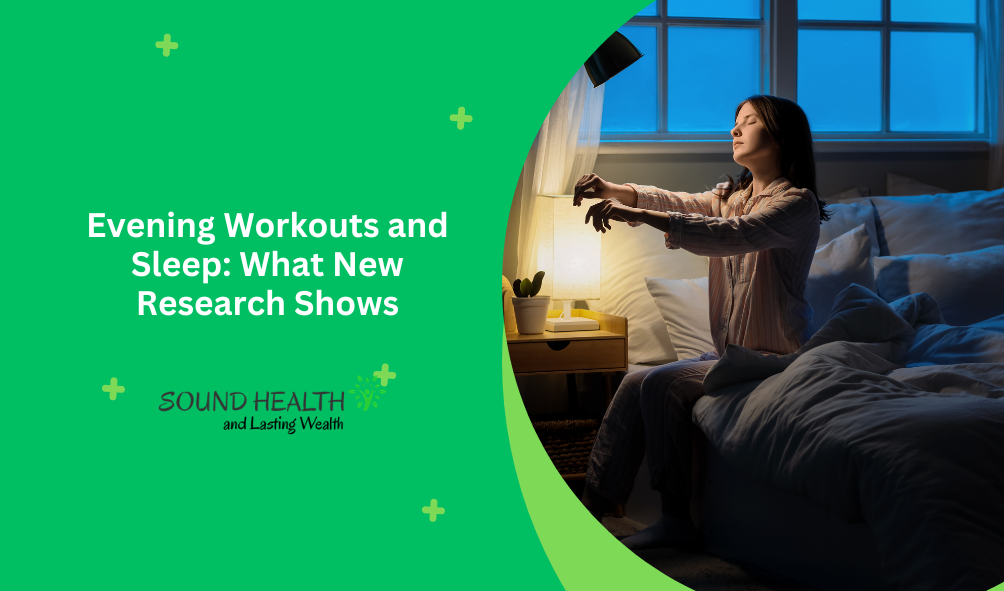

For decades, sleep advice included one firm rule: do not exercise in the evening. New research is rewriting that rule, and the surprises are not what most people expect.
The genuinely unexpected finding comes from the University of Otago. Breaking up a sedentary evening with short three-minute bursts of light activity every half hour led people to sleep about 30 minutes longer, without harming sleep quality (Gale et al., 2024). The old advice assumed movement before bed was the enemy. It turns out that sitting still all evening may be part of the problem.
But there is an important catch, and honest reporting requires stating it. The largest study of its kind, from Monash University, found that hard, high-intensity workouts within four hours of bedtime do disrupt sleep (Leota et al., 2025). So the real story is not “evening workouts are good.” It is more useful than that: the type, intensity, and timing of evening movement decide whether it helps or hurts.

What you will learn:
- The surprising activity-breaks finding and what it means
- Why gentle evening movement can lengthen sleep
- When evening exercise genuinely backfires
- The four-hour rule for intense workouts
- How to build an evening routine that supports sleep
The Old Rule, and Why It Is Being Questioned
Traditional sleep hygiene guidance advised against exercising in the evening, on the logic that physical activity raises heart rate, body temperature, and alertness, all of which oppose sleep. Some guidelines specifically recommended finishing exercise by mid-afternoon.
The problem is that this advice was built largely on assumptions and small laboratory studies, and it did not match what larger, real-world research kept finding. A meta-analysis of 23 experimental studies concluded that evening exercise, in general, does not impair sleep, with disruption mainly appearing after intense activity very close to bedtime (Stutz et al., 2019, as summarised in Kahn et al., 2021).
In other words, the blanket “no evening exercise” rule was too broad. The truth is more specific, and more useful.
Also Read | Herbal Tea Cured Her Insomnia When Nothing Else Worked
The Surprising Finding: Movement Breaks Beat Sitting Still
Here is the result that genuinely defies expectations.
Researchers at the University of Otago ran a randomised crossover trial, published in BMJ Open Sport & Exercise Medicine. Participants completed two different four-hour evening sessions: one of prolonged, uninterrupted sitting, and one where they interrupted sitting with three minutes of simple bodyweight resistance activity every 30 minutes (Gale et al., 2024).
The activities were deliberately gentle, the kind anyone can do in a living room: chair squats, calf raises, and standing knee raises. No gym, no equipment, no sweating.
The outcome was striking. After the activity-breaks evening, participants slept an average of about 27 to 30 minutes longer than after the sitting-only evening. Just as importantly, sleep quality and efficiency were not harmed. They simply slept more (CNN Health, 2024; Gale et al., 2024).
Why This Is So Unexpected
Two long-held beliefs are challenged here:
- That any movement before bed disrupts sleep. These light breaks lengthened it.
- That resistance exercise is too stimulating for the evening. Brief, light bouts were beneficial.
The lead researchers noted that for many people, the longest stretch of uninterrupted sitting in the whole day happens at home in the evening, in front of a screen. Breaking that up, rather than adding a formal workout, appears to be the lever.
One honest caveat: this was a small study of 28 healthy women aged 18 to 40, in a supervised setting. It is a promising and genuinely novel result, not the final word. Larger and more varied studies are underway. Treat it as an encouraging signal, not a guarantee.
Why Gentle Evening Movement May Help Sleep
Researchers are still working out the mechanisms, but several plausible explanations fit the evidence.
- Less prolonged sitting. Extended uninterrupted sitting has metabolic effects, and breaking it up improves post-meal blood sugar and fat handling. Better metabolic regulation in the evening may support sleep.
- Gentle physical tiredness. Light muscular activity spread across the evening may contribute to a mild, natural readiness for sleep without the alertness spike of a hard workout.
- Avoiding the wind-up. Because the activity is light, it does not trigger the surge in stress hormones and cardiac strain that intense late exercise does.
The key distinction throughout this research is intensity. Light and moderate movement behaves very differently from hard, strenuous exercise when it comes to sleep.
Also Read | Insomnia Relief Found: One Woman’s Red Light Therapy Success Story
The Other Side: When Evening Exercise Backfires
Balanced reporting means giving the counter-evidence equal weight, because it is strong and recent.
The Monash University study, published in Nature Communications, is the largest of its kind. Researchers tracked 14,689 people across a full year, capturing roughly four million nights of data using a wearable biometric device (Leota et al., 2025).
Their finding was clear and consistent: exercising within four hours of bedtime, especially at higher intensity, was linked to:
- Falling asleep later
- Getting less total sleep
- Worse sleep quality
- A higher resting heart rate overnight
- Lower heart rate variability, a marker of poorer recovery
The effect followed a dose-response pattern, meaning the later and harder the workout, the greater the disruption. Very intense sessions close to bedtime were associated with meaningfully delayed sleep onset and shorter sleep (The Whole Health Practice summary of Leota et al., 2025).
The mechanism makes sense: hard exercise keeps the body in a heightened, activated state, reducing the parasympathetic “rest and digest” activity that normally helps you wind down.
Reconciling the Two Findings
These studies do not contradict each other. They describe different things:
| Otago activity breaks | Monash evening exercise | |
|---|---|---|
| Type of activity | Brief, light, spread out | Continuous workouts, often intense |
| Intensity | Low | Moderate to high |
| Effect on sleep | Sleep about 30 min longer | Disrupted when intense and close to bed |
| Takeaway | Break up sitting with gentle movement | Keep hard workouts well before bedtime |
The unifying message: gentle evening movement can help; strenuous late-evening workouts can hurt.
The Practical Rules for Evening Exercise and Sleep
Drawing the evidence together gives clear, usable guidance.
If You Exercise Intensely
- Aim to finish hard workouts at least four hours before bedtime where possible (Leota et al., 2025).
- If your only window is closer to bed, reduce the intensity rather than skipping movement entirely.
If You Are Within a Few Hours of Bed
- Choose light to moderate activity: a gentle walk, easy cycling, stretching, or yoga.
- These are unlikely to disrupt sleep and may help you unwind.
If You Spend the Evening Sitting
- Break it up. Stand and do two to three minutes of light movement every half hour or so.
- Simple options: chair squats, calf raises, marching on the spot, a lap of the house.
- This is the finding most people have never heard, and it costs nothing to try.
Read Your Own Response
- Individual variation is real. Some people sleep fine after a late run; others do not.
- Track how you sleep after different evening activities and find your own pattern.
Also Read | Coffee Side Effects: From Addiction, To Insomnia – Will This Happen To You?
A Simple Evening Movement Routine
If you want to try the activity-breaks approach during an evening of screen time, this is an example. Keep everything light and comfortable.
- Every 30 minutes, pause what you are watching.
- Do about three minutes of gentle movement, such as:
- 10 to 15 slow chair squats
- 15 calf raises
- 20 marching steps on the spot
- A slow walk to the kitchen and back
- Sit back down and continue.
- Repeat through the evening, stopping well before bed.
The goal is not to raise a sweat or your heart rate. It is simply to avoid long, unbroken stretches of stillness.
Foods, Habits, and the Wind-Down
Exercise is one piece. These support the same goal of easing into sleep.
Helpful in the evening:
- A consistent wind-down routine and regular sleep and wake times
- Dim lighting in the last hour or two before bed
- A cool, dark bedroom
Best limited before bed:
- Caffeine, which has a half-life of roughly five to six hours
- Alcohol, which speeds sleep onset but fragments the second half of the night
- Large, heavy meals close to bedtime
- Bright screens right up to lights-out
Myths vs. Facts
| Myth | Fact |
|---|---|
| You should never exercise in the evening | Light to moderate evening movement generally does not harm sleep and may help. |
| All evening movement raises alertness and blocks sleep | Brief, light activity breaks lengthened sleep in a randomised trial. |
| Resistance exercise is always too stimulating at night | Short, light bodyweight bursts were beneficial in the Otago study. |
| Any workout before bed is fine | Intense workouts within four hours of bed can disrupt sleep. |
| Sitting quietly all evening is best for sleep | Prolonged evening sitting may be part of the problem, not the solution. |
| One rule fits everyone | Individual response varies; personal tracking matters. |
Common Mistakes to Avoid
- Doing an intense workout right before bed. Aim to finish hard sessions about four hours prior.
- Skipping evening movement entirely out of fear. Gentle activity is likely fine and may help.
- Sitting unbroken for hours before bed. Break it up with short movement.
- Assuming resistance work is off-limits at night. Brief, light bouts appear beneficial.
- Ignoring your own signals. If a late run wires you, shift it earlier.
- Expecting a movement tweak to fix real insomnia. Persistent insomnia needs proper assessment.
When to See a Doctor
Adjusting evening movement is a reasonable self-care step. Some sleep problems need more than a routine tweak. See a doctor if you:
- Have had difficulty falling or staying asleep at least three nights a week for three months or more
- Wake unrefreshed despite adequate time in bed
- Snore loudly, gasp, or have been told you stop breathing in your sleep
- Have an uncomfortable urge to move your legs in the evening
- Experience daytime sleepiness that affects driving, work, or safety
For persistent insomnia, cognitive behavioural therapy for insomnia (CBT-I) is the recommended first-line treatment, and it is more effective long term than adjusting habits alone. Evening movement can support good sleep, but it is not a treatment for a diagnosable sleep disorder.
Action Steps
- Note your usual bedtime and count back four hours; keep intense workouts before that mark.
- If you exercise close to bed, switch to light activity such as a walk, stretching, or yoga.
- On sedentary evenings, take a three-minute movement break every 30 minutes.
- Keep the breaks genuinely light, no sweating required.
- Track your sleep for two weeks to find your personal pattern.
- If sleep problems persist despite good habits, speak to a doctor about CBT-I.
Also Read | Sleep Problems Linked to Higher Heart Disease Risk After 45
Frequently Asked Questions
Is it bad to work out in the evening?
Not usually. Light to moderate evening activity generally does not harm sleep and may help. The main exception is intense exercise within about four hours of bedtime, which can disrupt sleep.
What is the surprising new finding about evening exercise and sleep?
A University of Otago trial found that interrupting an evening of sitting with short three-minute bursts of light activity every 30 minutes led people to sleep roughly 30 minutes longer, without harming sleep quality.
How long before bed should I stop intense exercise?
Research from Monash University suggests finishing hard, high-intensity workouts at least four hours before bedtime where possible, to reduce the risk of disrupted sleep.
What kind of evening exercise is best for sleep?
Light to moderate activity such as walking, gentle cycling, stretching, or yoga. Short, light resistance breaks during a sedentary evening also appear helpful.
Will evening exercise cure my insomnia?
No. It can support healthy sleep, but persistent insomnia is a medical issue best addressed with cognitive behavioural therapy for insomnia and a proper assessment.
Does everyone react to evening exercise the same way?
No. Individual response varies. Some people sleep fine after a late workout, while others are kept awake. Tracking your own sleep helps you find what works.
Are these findings strong enough to change what I do?
The evidence is promising and growing. The activity-breaks study was small and specific, while the intensity-and-timing findings come from very large data. Both point in a practical direction worth trying.
Key Takeaways
- The old “never exercise in the evening” rule is being revised by newer, larger research.
- A University of Otago trial found that short, light activity breaks during a sedentary evening led to roughly 30 minutes more sleep, without harming sleep quality.
- The largest study to date, from Monash University, found that intense workouts within four hours of bedtime disrupt sleep and overnight recovery.
- The unifying lesson: gentle evening movement can help, while strenuous late workouts can hurt.
- Finish hard sessions about four hours before bed; keep anything closer light.
- Breaking up prolonged evening sitting is the surprising, low-effort strategy most people have never tried.
- Individual response varies, and persistent insomnia needs medical care, not just a routine change.
The Bottom Line
The headline that evening workouts can improve sleep in unexpected ways holds up, but the real lesson is more precise and more practical than a slogan. Sleep does not respond to whether you move in the evening so much as to how you move.
Short, light bursts of activity that break up a long sedentary evening appear to lengthen sleep, a finding that overturns the old advice to sit quietly and avoid movement before bed. At the same time, hard, high-intensity workouts crammed into the last few hours before sleep genuinely can disrupt it. Both things are true, and holding them together is what makes the guidance useful.
If you take one idea from the newest research, make it this: on the evenings you would otherwise spend sitting still for hours, get up and move gently for a few minutes each half hour. It is free, it is easy, and the early evidence suggests your sleep may thank you for it.
Also Read | Women With These 5 Sleep Habits Live Longer, Study Finds
References
Gale, J. T., Haszard, J. J., Wei, D. L., Taylor, R. W., & Peddie, M. C. (2024). Evening regular activity breaks extend subsequent free-living sleep time in healthy adults: A randomised crossover trial. BMJ Open Sport & Exercise Medicine, 10(3), e001774. https://doi.org/10.1136/bmjsem-2023-001774
Kahn, M., Korhonen, T., Leinonen, L., Martinmaki, K., Kuula, L., Pesonen, A.-K., & Gradisar, M. (2021). Is it time we stop discouraging evening physical activity? New real-world evidence from 150,000 nights. Frontiers in Public Health, 9, 772376. https://doi.org/10.3389/fpubh.2021.772376
Leota, J., Presby, D. M., Le, F., Czeisler, M. E., Mascaro, L., Capodilupo, E. R., Wiley, J. F., Drummond, S. P. A., Rajaratnam, S. M. W., & Facer-Childs, E. R. (2025). Dose-response relationship between evening exercise and sleep. Nature Communications, 16. https://doi.org/10.1038/s41467-025-58271-x
Mayo Clinic. (2024). Exercising for better sleep. https://www.mayoclinic.org/healthy-lifestyle/adult-health/expert-answers/exercise/faq-20057943
Monash University. (2025, April 16). Exercise before bed is linked with disrupted sleep: study. https://www.monash.edu/news/articles/exercise-before-bed-is-linked-with-disrupted-sleep-study
National Health Service. (2024). Insomnia. https://www.nhs.uk/conditions/insomnia/
University of Otago. (2024, July 16). Evening activity for better sleep, Otago study. https://www.otago.ac.nz/news/newsroom/evening-activity-for-better-sleep-otago-study
World Health Organization. (2020). WHO guidelines on physical activity and sedentary behaviour. https://www.who.int/publications/i/item/9789240015128